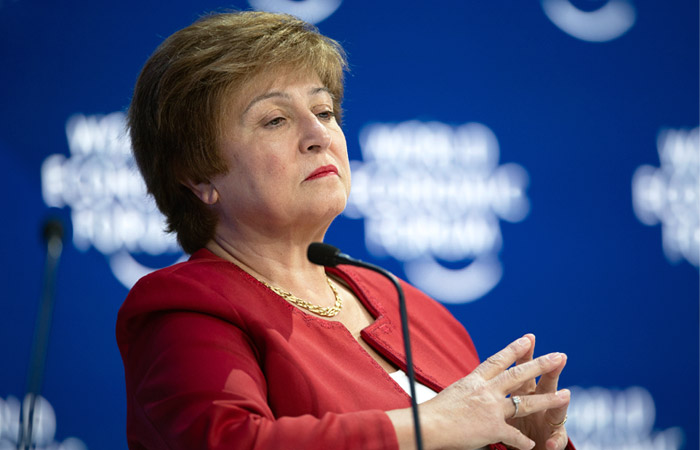
Tajikistan’s state-run news agency Khovar says the International Monetary Fund (IMF) Managing Director Kristalina Georgieva will arrive in Dushanbe on May 16 on a three-day visit.
While in Dushanbe, Ms. Giorgieva will hold talks with a number of high-ranking Tajik state officials to discuss cooperation issues.
The IMF managing director is also scheduled to get acquainted with the progress of construction of the Roghun hydropower plant.
Recall, the IMF Executive Board approved a twenty-two-month Policy Coordination Instrument (PCI) for Tajikistan on February 28 this year. According to IMF press release, Tajikistan’s favorable post-pandemic economic performance continued in 2023, with strong, broad-based growth and low inflation. The fiscal deficit has remained anchored within the authorities’ medium-term deficit target, contributing to a further reduction in the public-debt-to-GDP ratio. The outlook for 2024 reportedly appears favorable, although there remains considerable uncertainty over the external environment.
Tajik authorities requested approval of a 22-month program supported by the PCI to anchor economic policies and support implementation of vital structural reforms. The PCI aims to maintain macroeconomic stability, strengthen the authorities’ policy frameworks and support their efforts to foster more sustainable and inclusive growth. Program reviews will take place on a semi-annual fixed schedule. While the PCI involves no use of IMF resources, a favorable performance under the program would signal to development partners and private investors Tajikistan’s commitment to strong economic and structural policies, catalyzing financing for high-priority social and infrastructure projects.
Press release issued by the IMF on April 2 notes that Tajikistan’s economic performance remains favorable as remittance inflows and public investment continue to support domestic demand but there is uncertainty over the outlook in the context of heightened geopolitical tensions. Public debt is sustainable but sizeable investment needs constrain fiscal space, and the risk of debt distress remains high due to upcoming Eurobond repayments.
The Republic of Tajikistan joined the International Monetary Fund on April 27, 1993.