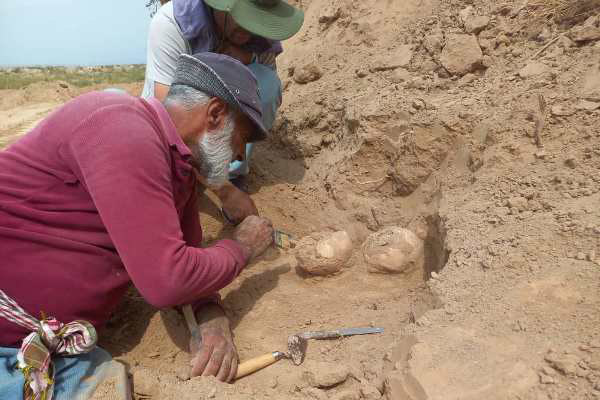
Archeological excavations conducted in the ruins of the ancient city of Halqajar in Khoroson district of Khatlon province in early June have led to discovery of the remains of tomb, says the National Museum of Tajikistan.
Inside the tomb, researchers reportedly discovered various artifacts, including ceramic ware and ceramic lamp, weaving spindle, bronze mirror, copper coins, iron products and gold jewelry.
Mr. Muhsin Bobomulloyev, the senior specialist of Department of Archeology and Numismatics at the National Museum of Tajikistan, says the discovered artifacts date back to the Kushan period (the 2nd century BC – the 3rd century AD) and indicate the development of pottery, copper and jewelry crafts in this region during that period.
Recall, archeological excavations conducted in the ruins of Halqajar city in 2020 led to the discovery of remains of a tomb of a wealthy nobleman, remains of his dwellings, pottery, coins and more, depicting human and lion figures.
A coin of the Kushan king Vasudeva, which dates back to 300 AD is among the findings. The most important find, however, is a gold ornament decorated with precious stones and a image of centaur – an imaginary half-man, half-horse creature of Greek mythology.
Halqajar was one of the most developed cities of the Kushan period, and locals have found a large number of Kushan coins and other ancient tools around during their seasonal cultivations.
A treasure trove of gold coins of Kushan king Havishka was found here in 1999. Such archeological findings open a new page in the history of Tajikistan in the time of Kushans (200 BC – 300 AD), making it available to the public and scientists.