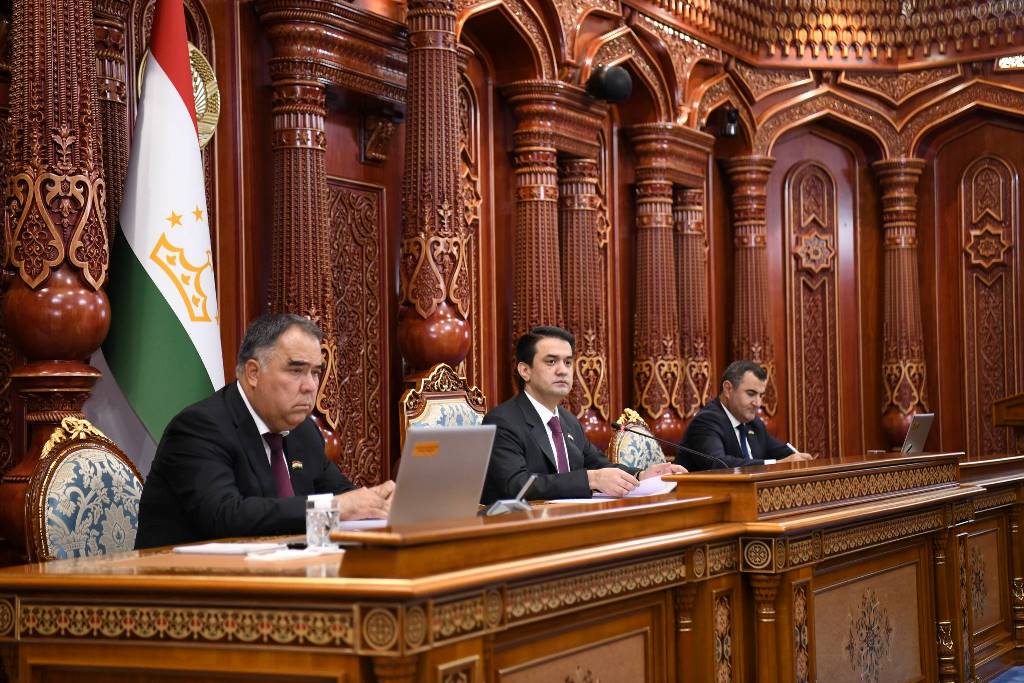
The Majlisi Milli (Tajikistan’s upper chamber of parliament) has seconded the law banning “alien garments” and children's celebrations for two major Islamic holidays — Eid al-Fitr (Idi Ramazon) and Eid Al-Adha (Idi Qurbon), known as idgardak (children visit houses of their street or village and congratulate people with Islamic holidays Ramazon or Qurbon).
The 18th session of the Majlisi Milli, presided over by its head, Rustam Emomali, took place on June 19.
The Majlisi Milli press center says the session seconded amendments made to the country’s laws on holidays, traditions and rituals, role of teachers and educational institutions in raising children, parental responsibilities.
Recall, the Majlisi Namoyandagon (Tajikistan’s lower chamber of parliament) approved the bill banning hijab and idgardak on June 8.
The law mostly targets the hijab, or Islamic head scarf, and other traditional items of Islamic clothing, which started coming to Tajikistan in recent years from the Middle East and the country’s officials have associated them with Islamic extremists.
Lawmakers also approved new amendments to the code of administrative violations, which include hefty fines for offenders. The code did not previously list the wearing of a hijab or other religious clothing as violations.
Radio Liberty’s Tajik Service reported on May 23 that the penalties for offenders vary from the equivalent of 7,920 somonis for individuals and to 39,500 somonis for legal entities. Government officials and religious authorities reportedly face much higher fines of 54,000 somonis and 57,600 somonis, respectively, if found guilty.
It is to be noted that Tajikistan has outlawed Islamic Hijab after years of unofficial ban. The Tajik authorities’ clampdown on the hijab began in 2007 when the Education Ministry banned both Islamic clothing and Western-style miniskirts for students.
The ban was eventually extended to all public institutions, with some organizations demanding that both their staff and visitors remove their head scarves.
Local governments set up special task forces to enforce the unofficial ban, while police raided markets to detain “offenders.” But authorities reject numerous claims from women who said they were stopped on the street and fined for wearing the hijab.
The government in recent years conducted a campaign to promote Tajik national dress. On September 6, 2017, millions of cell phone users received text messages from the government calling for women to wear Tajik national clothes. The messages stated that “Wearing national dress is a must!” “Respect national dress,” and “Let us make it a good tradition to wear national clothes.”
The campaign culminated in 2018 when the government introduced a 376-page manual — The Guidebook Of Recommended Outfits In Tajikistan — which outlined what Tajik women should wear for different occasions.
Tajikistan has also unofficially banned bushy beards. Thousands of men in the past decade have reportedly been stopped by police and had their beards shaved against their will.