This year, the 18th edition of the Global Gender Gap Index benchmarks gender parity across 146 economies, providing a basis for the analysis of gender parity developments across two-thirds of the world’s economies. Further, the index examines a subset of 101 countries that have been included in every edition of the index since 2006, offering a broad country sample for longitudinal and trend analysis. The Global Gender Gap Index measures scores on a 0-100 scale and scores can be interpreted as the distance covered towards parity (i.e. the percentage of the gender gap that has been closed). Cross-country comparisons support the identification of the most effective policies to close gender gaps.
Key findings include the index results in 2024, trend analysis of the trajectory towards parity and in-depth examination of historical and emerging patterns through new metrics partnerships and contextual data.
The global gender gap score in 2024 for all 146 countries included in this edition reportedly stands at 68.5% closed. Compared against the constant sample of 143 countries included in last year’s edition, the global gender gap has been closed by a further +.1 percentage point, from 68.5% to 68.6%. When considering the 101 countries covered continuously from 2006 to 2024, the gap has also improved +.1 points and reached 68.6%.
The lack of meaningful, widespread change since the last edition effectively slows down the rate of progress to attain parity. Based on current data, it will take 134 years to reach full parity – roughly five generations beyond the 2030 Sustainable Development Goal (SDG) target.
The Global Gender Gap Index annually benchmarks the current state and evolution of gender parity across four key dimensions: economic participation and opportunity; educational attainment; health and survival; and political empowerment. Since launching in 2006, it is the longest-standing index tracking the progress of numerous economies’ efforts towards closing these gaps over time since its inception in 2006.
In the 2024 Global Gender Gap Index, Tajikistan slightly worsened its position compared to last year, dropping from 111th to 112th place among 146 countries.
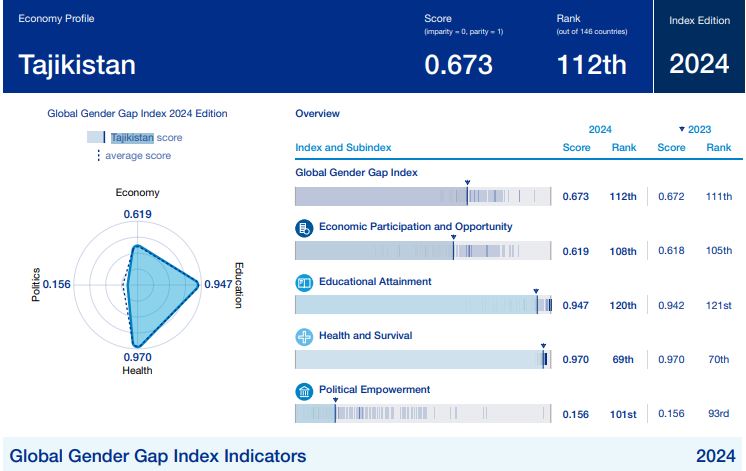
The index annually analyzes the current state and evolution of gender equality across four key indicators: economic opportunities; educational attainment; health and survival; and political empowerment.
Challenges in politics, improvement in health
Tajikistan's ranking reflects mixed progress. While the country shows improvements in health and survival, it lags in political empowerment and economic participation for women.\
Economic participation
Tajikistan is ranked 108th for women's economic participation, falling three places from the previous year. This indicator considers factors such as labor force participation, wage equality, and the presence of women in leadership roles.
Educational attainment
In terms of access to education, Tajikistan has improved slightly, moving up one place to 120th. This metric evaluates enrollment in primary, secondary, and tertiary education, as well as literacy rates.
Health and survival
Significant progress has been made in the health and survival category, where Tajikistan ranks 69th, up from 88th in 2021. Over the last three years, there have been considerable improvements in women's healthcare. For instance, the maternal mortality rate is 17 per 100,000 live births, and the total fertility rate is 3.19 births per woman. Additionally, the incidence of gender-based violence over a lifetime has decreased from just over 20% to 14% this year.
Political empowerment
However, the situation has worsened in terms of involvement of women in politics. Tajikistan's ranking in this category has dropped from 93rd to 101st. The decrease is attributed to the declining proportion of women in legislative and managerial positions.
In summary, while Tajikistan has made notable strides in healthcare for women, it still faces challenges in achieving gender equality in political representation and economic participation. Continued efforts are needed to improve women's access to education and to address barriers to their full participation in the workforce and political life.
The 2024 Global Gender Gap Index shows that while no country has achieved full gender parity, 97% of the economies included in this edition have closed more than 60% of their gap, compared to 85% in 2006.
Iceland (93.5%) is again ranked 1st and has been leading the index for a decade and a half. It also continues to be the only economy to have closed over 90% of its gender gap. Alongside Iceland, the top five also includes long-standing high performers such as Finland (2nd, 87.5%, up one position from 2023); Norway (3rd, 87.5%, down one position from last year); and Sweden (5th, 81.6%). New Zealand (4th, 83.5%) makes the top five for the 5th year in a row, and 9th year overall.
This year, the bottom 10 include Morocco, Niger, Algeria, Democratic Republic of the Congo, Mali, Guinea, Iran, Chad, Pakistan and Sudan.