



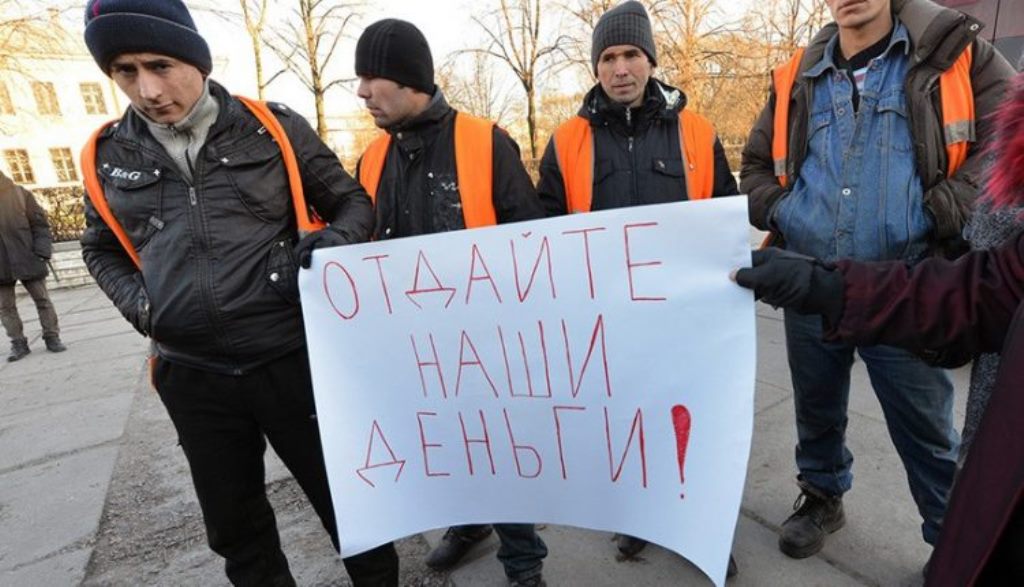
Tajik labor migrants working Russia helped to be paid back RR18 million unpaid wages in H1, 2024

Over the first six months of this year, the representative office of Tajikistan’s Ministry of Labor, Migration and Employment of the Population (MoLMEP) in Russia has reportedly negotiated the payment of 18,023,987 Russian rubles (RR) of unpaid back wages to Tajik labor migrants working in the Russian Federation.   The MoLMEP representative office’s press center says […]

Over the first six months of this year, the representative office of Tajikistan’s Ministry of Labor, Migration and Employment of the Population (MoLMEP) in Russia has reportedly negotiated the payment of 18,023,987 Russian rubles (RR) of unpaid back wages to Tajik labor migrants working in the Russian Federation.  

The MoLMEP representative office’s press center says the reasons for non-payment of wages to migrant workers are varied, but most often they are associated with the lack of an employment contract with the employer and insufficient control over the fulfillment of obligations on the part of the contractor.  

“Disorganized and unclear verbal consultation with the employer can lead to situations when the report on the work performed is not agreed upon between the parties, which makes it difficult to confirm the work performed,” says the MoLMEP representative office’s press center. 

With each passing year, labor migrants from Tajikistan in Russia come up against new difficulties in securing work permits and formalizing their right to live in the country.  

In some regions, local authorities have introduced restrictions on where migrants can work.  Thus, in some oblasts, expat laborers are prohibited from working in the production of baby food and dietary food products.  Other off-limits areas are public transportation, the hotel industry, education and healthcare at all levels, and beauty and massage parlors.

Where they are able to work, labor migrants often run the risk of not getting paid.

Employment contracts are often nonexistent and it similarly common for workers to be hired off the books.  Workers can be employed by people whose names they do not know and companies whose legal address is a mystery.  The option of going through the legal system to press employers to pay back wages is usually only available when all the rules have been followed.


Join us on social media!

Article translations:

Related Article

Tenisi
Оби зулол
Оби зулол

Most Read

Коммерсбонк Точикистон

Recent Articles

RZD announces the restoration of passenger services between Moscow and Dushanbe

Direct rail services between the capitals of Russia and Tajikistan were suspended in March 2020 due to the COVID-19 pandemic.

#AP30/Stories. “Selam! Heller nichek?” How Tatars live today in Sughd province

On the 30th anniversary of "Asia-Plus," we continue to publish reports that remain relevant even after years. This story was told in 2021, and since then, little has changed in the life of the Tatar community in Tajikistan.

15,000 cameras, drones, and robots: how technology monitors pilgrims in Mecca and Medina

During Hajj 2026, Mecca and Medina were under unprecedented digital control.

Another child in Dushanbe removed from family and sent to boarding school

The Ministry of Internal Affairs reports that the parents did not pay adequate attention to the child.

Emomali Rahmon instructs to address issues in seed production following criticism of the industry

Issues have been noted with certification, seed quality, and the material and technical base of the industry.

Water, climate, and a $130 billion deficit: seven key outcomes of the Water Conference in Dushanbe

At the forum, countries and international organizations discussed new mechanisms for cooperation, investments, and technologies that are essential for addressing the global water crisis.

Eskhata Bank introduces a new generation children’s wallet

"Eshkata Bank" has created a full-fledged digital platform that helps children aged 7 to 16 learn how to manage money.





