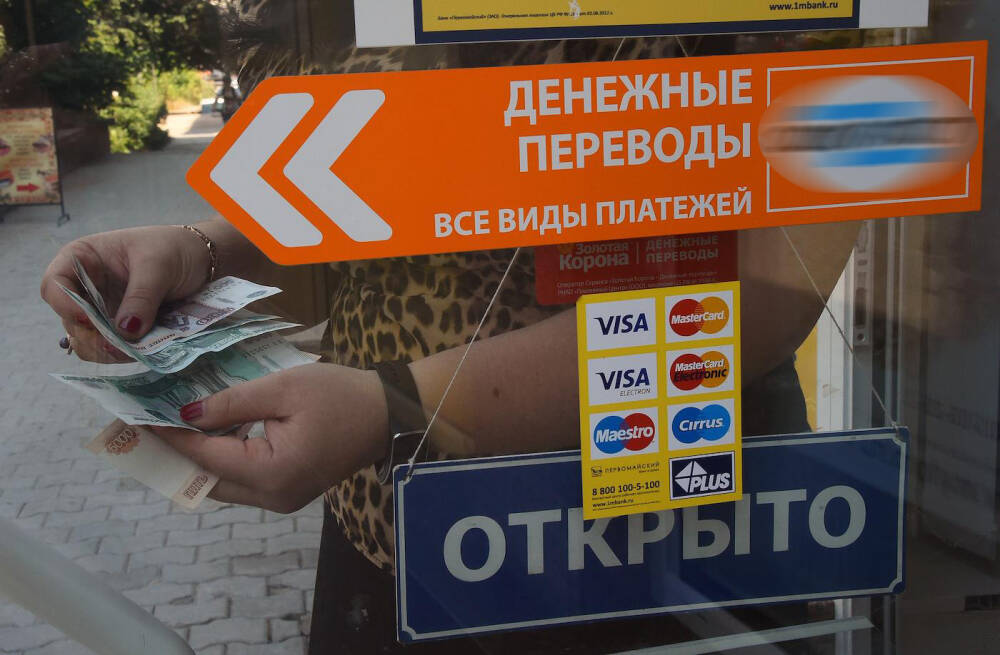
Over the first quarter (January-March) of this year, the inflow of remittances to Tajikistan has increased by 56% compared to the same period last year, according to the weekly macroeconomic outlook by the Eurasian Development Bank (EDB).
The Bank analysts attribute this growth to the increase in international labor mobility and strong economic activity in countries neighboring Tajikistan.
EDB specialists note that these figures support their assessment of remittance dynamics in Tajikistan as favorable for the economy. “We expect that the increase in the volume of incoming remittances will be one of the factors driving GDP growth to 8.0% in 2024," the report concludes.
As it had been reported earlier, remittance inflows to Tajikistan suddenly surged 83.0% in 2022 to US$5.3 billion, almost double the US$2.9 billion in the previous year. In 2023, this further went up by 6.6% to US$5.7 billion.
Experts from international financial institutions had anticipated a decline in remittance levels from Russia following the onset of the Russia-Ukraine conflict. Contrary to these predictions, remittance volumes sharply increased in 2022.
A report by the World Bank, “Migration and Development Brief”, which was released in November 2022 says the growth of global remittance flows is expected to be 4.9 percent in 2022. Remittance flows to developing regions were reportedly shaped by several factors in 2022. Besides the determination of migrants to help their families back home, a gradual reopening of various sectors in host countries’ economies expanded many migrants’ income and employment situation. On the other hand, rising prices adversely affected migrants’ real incomes and their remittances. In Russia, rising oil prices and continued demand for migrant workers reportedly increased the flow of remittances to Central Asian countries.
According to the report, it was anticipated that remittances to the CIS would plummet in the wake of the Russian invasion of Ukraine. But Kyrgyzstan, Tajikistan, and Uzbekistan likely received record high amounts of remittances from Russia in 2022, as the number of migrant workers in Russia from Central Asia remained strong (in part due to a strong ruble).
However, some experts in Tajikistan attribute the significant increase in remittance volumes over the past two years not only to the growth of economic activity in Russia, including the expansion of the defense industry, but also to the rising level of Tajik migration to Europe and North America.
Limited employment opportunities in Tajikistan push workers to seek better employment abroad, primarily in the Russian Federation in the construction and services sectors.
Tajikistan is one of the world’s most remittance dependent countries and remittances keep many struggling families at home above the poverty line.
Although, labor migrants still remain a critical component in the country’s economy, Tajik authorities, stopped publishing information on the volume of remittances sent to Tajikistan in May 2013. In a report released in Dushanbe, the then head of the National Bank of Tajikistan, Abdujabbor Shirinov, revealed on July 23, 2013 that Tajikistan will no longer release cash transfer data. According to him, the government stopped publishing information on the volume of remittances sent to Tajikistan in May. “I’d rather not talk about migrants'' funds because this issue may be politicized,” Abdujabbor Shirinov said.
The lack of accessible official data presents challenges for a comprehensive analysis of the trends and their implications.
Accurately determining the number of Tajik labor migrants in Russia is challenging due to significant discrepancies in official data from both countries.
Russian statistics indicate that more than 1.5 million Tajik citizens live and work in Russia, while Tajikistan’s relevant authorities claim the number is less than 1 million.
According to Tajikistan's Ministry of Labor, Migration and Employment of the Population, just over 600,000 people left the country for labor migration in 2023.
However, Russian migration authorities report that over 800,000 Tajik labor migrants entered Russia in search of work in the first nine months of the year alone.