As external demand has improved, the economy of Tajikistan grew by 8.3 percent in 2023 and 8.2 percent during the first quarter of 2024, says a report released by the World Bank.
“Tajikistan Economic Update: Focusing on the Footprint of State-Owned Enterprises and Competitive Neutrality, Summer 2024” notes that this was driven mainly by higher gold export revenue, private consumption and increased public infrastructure spending.
Domestic demand has been supported by an increase in the inflow of workers’ remittances and a higher public wage bill in 2023, contributing to further poverty reduction. Domestic consumer-price inflation has benefited from subsiding global food and fuel prices and some tightening of monetary policy. Increased external grant support from development partners has helped to maintain fiscal discipline, leading to a further decline in public debt.
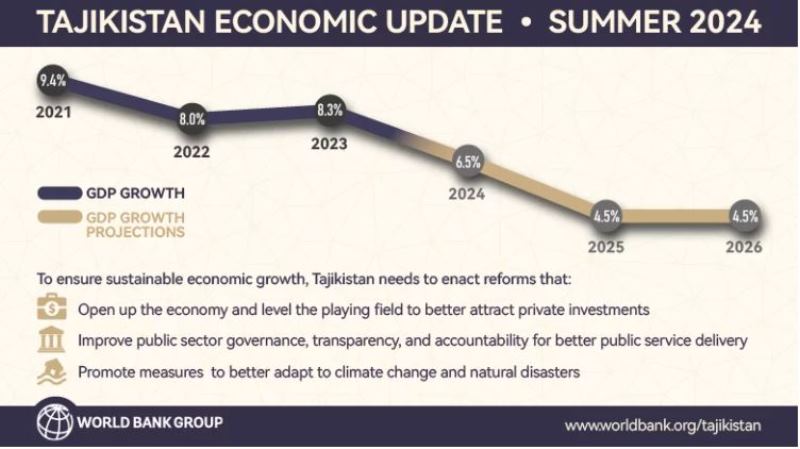
The report, in particular, notes that Tajikistan's economic prospects are overshadowed by regional uncertainty. Due to anticipated sluggish growth in key trading partners and an internal structural reform inertia, the medium-term growth rate is projected to be at about 6.5 percent in 2024 and 4.5 percent thereafter. Remittances, a significant growth driver, are expected to moderate and impact private consumption and investment. Inflation is projected to rise and be driven by electricity tariff hikes, and increased public service wages. The fiscal deficit is projected to widen in 2024, with tax revenue collection decreasing because of a value-added tax rate cut and heightened spending needs for the Roghun Hydropower Plant Project. Tajikistan will remain a country at a high risk of debt distress until Roghun-related Eurobonds are fully paid back during 2025-2027.
Risks to the economic outlook include a potential escalation of global and regional tensions and the Russian Federation's tighter migration policies, both of which could affect labor migration and give rise to energy price increases and higher logistics costs.
In particular, the Moscow terrorist attack of March 22, 2024, has led to tighter migration policies in Russia as well as police raids on Tajik labor migrants, thus raising the downside risks on remittance flows. For long-term competitiveness and inclusive growth, Tajikistan must prioritize structural reforms by further opening the economy to competition and private investment and improving public sector governance, transparency, and accountability for better public service delivery. Implementation of adaptation measures will be critical to mitigate the impacts of climate change and natural disasters on the economy.
The Tajikistan Economic Update is an annual report that analyzes recent economic developments, prospects, and policy issues in Tajikistan.