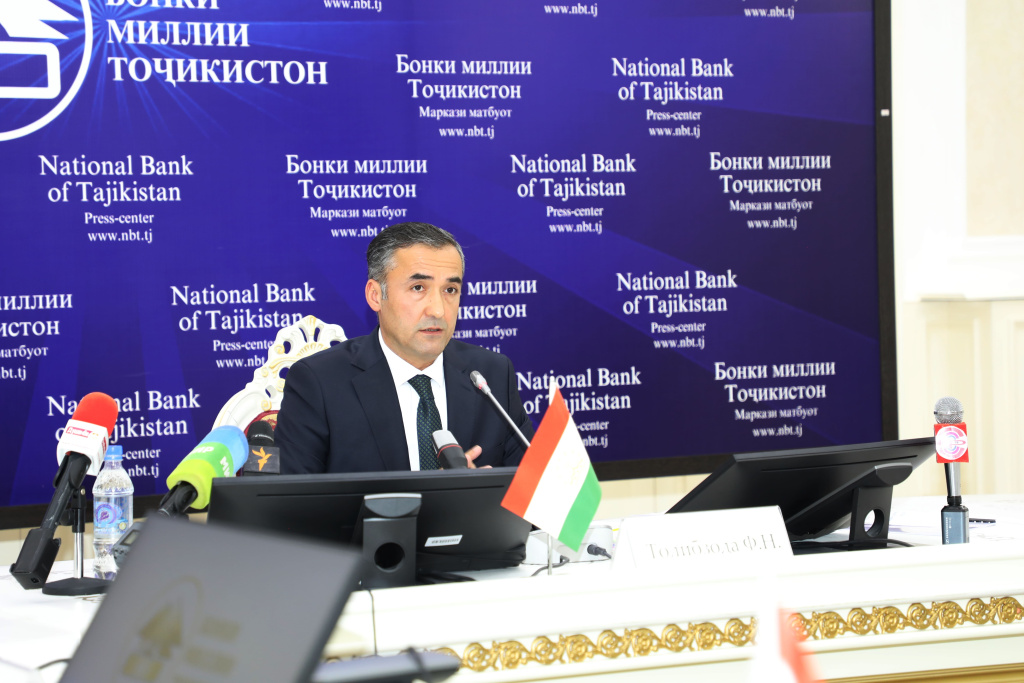
Chairman of the National Bank of Tajikistan Firdavs Tolibzoda, explaining the problems that arise when paying using a single QR code in shopping and service centers, said that they are mainly related to technical difficulties and are not always related to the banking system.
"The main problem is access to the Internet, which often creates obstacles. Or the problem may lie in the buyer's phone itself, which for technical reasons does not work or does not connect to the Internet. Another problem is the unwillingness of some retail and service outlets to use QR codes," the NBT chairman said at a press conference.
He stressed that banks have created all the necessary infrastructure to expand non-cash payments. As an example, he cited 10.4 million active electronic wallets (39% more compared to the same period last year) in the country, that is, "there is almost one wallet for each resident."
At the same time, he promised that, given the novelty of the process of using QR codes in the banking system, existing problems will be considered and resolved jointly with other structures.
Tolibzoda also said that with the introduction of a single QR code for non-cash payments, their number decreased by 3.5 thousand during the first six months of this year.
"Before installing a single QR code, each bank or credit institution used its own QR codes, which is why there were 4-5 QR codes at each checkout, and the customer did not know which one to transfer money to, which led to queues. After the development and implementation of a single QR code, all banks and credit organizations have entered their necessary information into it.
Therefore, we have removed all the individual QR codes and replaced them with a single QR code. Now any customer who has a mobile wallet of their bank can use a single QR code. As a result, a sharp decrease in the number of QR codes was observed within six months," Firdavs Tolibzoda noted.
The Chairman of the National Bank added that during this period, 16 thousand 472 single QR codes were installed in commercial and service institutions.
It should be recalled that trade and service points in Tajikistan began accepting payments using a single QR code on July 1 last year. Before that, to pay for goods and services, it was necessary to find signs with the QR code of the servicing bank.
A single QR code (Quick Response Code) is a matrix code (two–dimensional barcode) that contains information about the sender and recipient of funds and is designed to be scanned using a mobile device, barcode scanner and other devices in order to transfer the details of a money transfer operation.
The Chairman of the National Bank added that during this period, 16 thousand 472 single QR codes were installed in commercial and service institutions. It should be recalled that trade and service points in Tajikistan have begun to accept payments using a single payment method. The purpose of introducing a single QR code is to expand the payment infrastructure to ensure the reliability and efficiency of payments and stimulate the rapid development of non-cash payments.