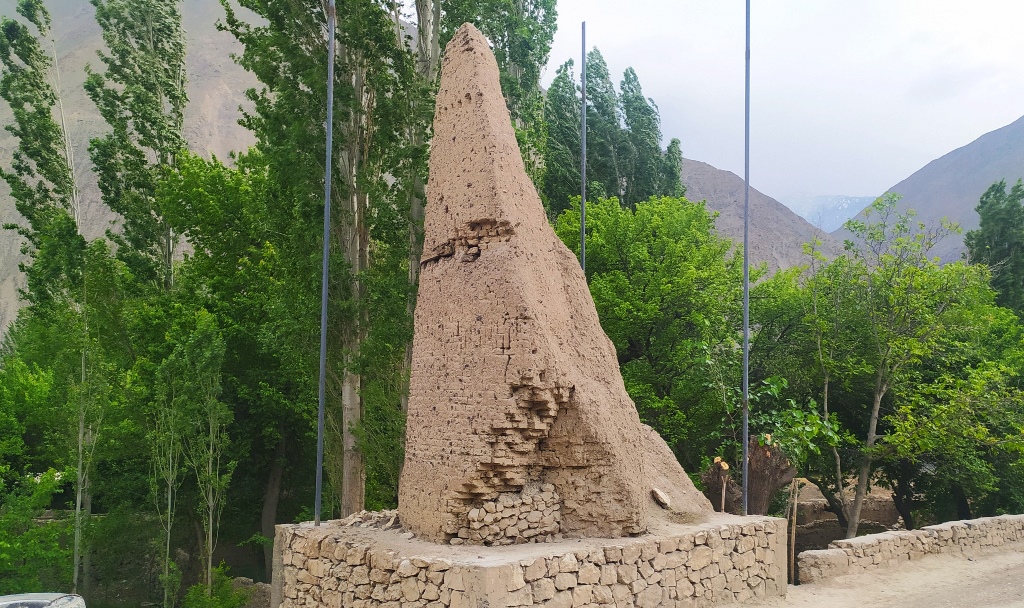
If you drive along the Dushanbe–Khujand highway to Aini and turn right into the area, climbing through the mountain villages, you can see many interesting historical places. One of which are the minarets.
In pre-Islamic times, light-skinned and light-eyed people who revered the cult of fire lived on the territory of Ancient Sogd. They worshipped Ahura Mazda, the sun god. This religion was widespread throughout Central Asia, as evidenced by the ruins of Zoroastrian temples.
When the conquerors who brought Islam came to this territory, the locals fought fiercely for their faith and did not immediately surrender to the mercy of the victor. Therefore, strengthening the new faith was not an easy task.
"The fiercest battles took place here, men were publicly beheaded, and local women were forcibly married. This is how the racial traits of our ancestors changed," says local resident Ruziboy Kholov, "if they used to belong to the Caucasian race, then with the arrival of the Arabs their appearance began to wear Asian features. As a result, the Arabs established their faith, and the old gods were forgotten here. Mosques have been built in each village so that everyone can pray."
In the old villages of the Zeravshan Valley, you can find turrets built by the Indian ruler of the Khalji dynasty.
By the way, the ancient Buddhist names of villages sound very unusual: Ispahn, Shamtuch, Veshab, Rarz, Fatmout, Fatmev, Kadamon, Isiz, Obrdon, Hudgifi soy, Hudgifi oftob... and not every native Tajik speaker is able to explain the meaning of these names.
In order for people to pray to Allah, seven mosques were built on the territory of the Ainin and Gorno–Matchinsky districts, each of which had a minaret tower. The first in the Zeravshan Valley was the Varz tower, installed in Aini (formerly Varzimanor, Zamkhatabad). It reaches 13.5 meters in height.
During Soviet times, the mosque in Aini was turned into a post office, and the minaret served as a mouthpiece for notifying residents of any news. Today, both the mosque and the tower are architectural monuments protected by the state, but the other three surviving towers seem to have been forgotten.
In ancient times, such towers served as a warning device, because it was convenient to shout from there that: enemies had come; someone had died, married or been born; it was time to pray. To date, there are only four such minarets left, and some have already turned into ruins.