UN General Assembly adopts pivotal UN Pact for the Future

The United Nations General Assembly has adopted a “Pact for the Future”, which UN Secretary-General Antonio Guterres described as a landmark agreement that is a “step-change towards more effective, inclusive, networked multilateralism”. The pact, which also includes an annex on working towards a responsible and sustainable digital future, was adopted without a vote on Sunday […]

Asia-Plus

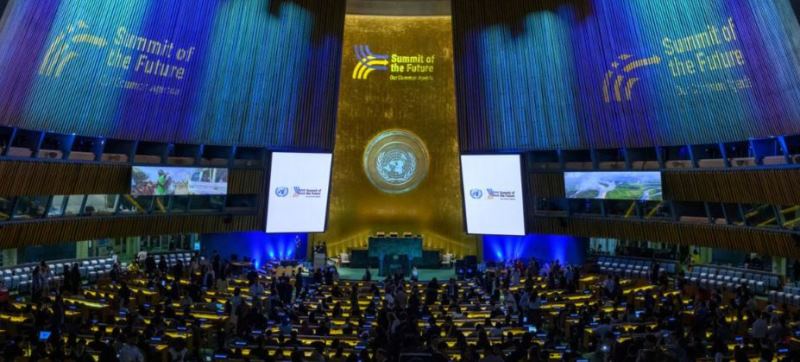
The United Nations General Assembly has adopted a “Pact for the Future”, which UN Secretary-General Antonio Guterres described as a landmark agreement that is a “step-change towards more effective, inclusive, networked multilateralism”.

The pact, which also includes an annex on working towards a responsible and sustainable digital future, was adopted without a vote on Sunday at the start of a two-day Summit of the Future.

The agreement came after some nine months of negotiations.  

As an opener for the annual high-level week of the UN General Assembly, which begins on Tuesday, dozens of heads of state and government had gathered for the adoption of the pact.

World leaders pledged to bolster the multilateral system to “keep pace with a changing world” and to “protect the needs and interests of current and future generations” facing “persistent crisis”.

“We believe there is a path to a brighter future for all of humanity,” the document of the pact said.

The pact covers themes including peace and security, global governance, sustainable development, climate change, digital cooperation, human rights, gender, youth and future generations.  It lays out some 56 broad actions that countries pledged to achieve.

The pact and its annexes – a Global Digital Compact and a Declaration on Future Generations – are nonbinding. This has reportedly raised concerns about implementation – especially as some principles, such as the protection of civilians in conflict, are violated daily.
Join us on social media!

Article translations:

Related Article

Оби зулол
Оби зулол

Most Read

Recent Articles

The only GPW veteran in Dushanbe allocated more than 80,000 somoni

The mayor's office of Dushanbe allocated him 25,000 somoni.

GITEX AI Kazakhstan 2026: how Almaty became the main AI hub of Central Asia

More than 300 companies and startups, over 200 speakers and 100 investors from 50 countries — the region is entering the global stage.

A trade and economic park to be built at the border junction of Tajikistan, Kyrgyzstan, and Uzbekistan

President of the Kyrgyz Republic Sadyr Japarov familiarized himself with the project.

A project to protect soil from degradation to be developed in Central Asia

The initiative is of great significance for the mountainous countries of the region, including Tajikistan.

Mudslide, death, and destroyed homes: hundreds of families in Tajikistan left homeless

A correspondent from "Asia-Plus" visited Kulob and spoke with the families of those who died and were affected by the disaster.

Spring 2026 bright event: new issue of VIPzone now on sale

This issue is about people and ideas that change everything: from business and investments to fashion, food, and urban environment.

Godfrey Sullivan: “Tajikistan is a promising market for Visa to develop digital payments”

The Vice President of Visa explained why Tajikistan is becoming a promising market for digital payments and how artificial intelligence is influencing the future of finance.

Seven students in Dushanbe were threatened with expulsion for arriving at universities in personal cars

The materials for each case have been sent to the Ministry of Education and Science for appropriate actions.

India’s blockchain push and lessons for the global south

The Indian Government has started pushing aggressively its agenda...

India’s blockchain push and lessons for the global south

The Indian Government has started pushing aggressively its agenda...