First endovascular brain surgery performed in Tajikistan

Doctors from Tajikistan's National Medical Center "Shifobakhsh," in collaboration with specialists from the Diagnostic and Treatment Center "Dastai Dil," have performed the country’s first complex endovascular brain surgery. An official source within the Ministry of Health and Social Protection of the Population (MoHSPP), says the procedure was carried out on a patient who had suffered […]

Asia-Plus

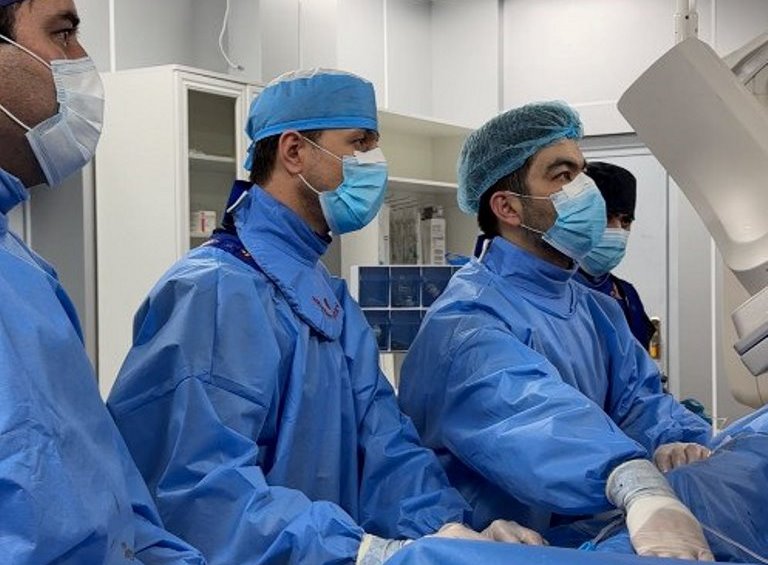
Doctors from Tajikistan's National Medical Center "Shifobakhsh," in collaboration with specialists from the Diagnostic and Treatment Center "Dastai Dil," have performed the country’s first complex endovascular brain surgery.

An official source within the Ministry of Health and Social Protection of the Population (MoHSPP), says the procedure was carried out on a patient who had suffered skull and brain injuries.

Using endovascular surgery—a minimally invasive technique without incisions—doctors addressed an issue involving damaged veins in the brain.  These injuries had caused swelling (which could have led to blindness) and bleeding from the nose and mouth.

The surgery, known as endovascular embolization of an aneurysm, is a minimally invasive procedure with no incisions and a short recovery period.  The surgery involves inserting a special "wire," a small, soft metal coil, into the affected vessel to block the blood supply to the aneurysm.

The patient’s condition stabilized after the procedure, and all preoperative complaints were fully resolved, the source added.

A MoHSPP has emphasized that this type of surgery is among the most complex in neurosurgery and had never been performed in Tajikistan before.  Previously, patients requiring such procedures had to travel abroad or rely on foreign specialists.

Neurosurgeon Subhoniddin Bahodurov, who led the surgery, was reportedly trained in Iran for 18 months, acquiring modern neurosurgical techniques.  

The expertise and dedication of Bahodurov and his team laid the foundation for this successful milestone in Tajikistan's medical history.

Join us on social media!

Article translations:

Related Article

Оби зулол
Оби зулол

Most Read

Recent Articles

The only GPW veteran in Dushanbe allocated more than 80,000 somoni

The mayor's office of Dushanbe allocated him 25,000 somoni.

GITEX AI Kazakhstan 2026: how Almaty became the main AI hub of Central Asia

More than 300 companies and startups, over 200 speakers and 100 investors from 50 countries — the region is entering the global stage.

A trade and economic park to be built at the border junction of Tajikistan, Kyrgyzstan, and Uzbekistan

President of the Kyrgyz Republic Sadyr Japarov familiarized himself with the project.

A project to protect soil from degradation to be developed in Central Asia

The initiative is of great significance for the mountainous countries of the region, including Tajikistan.

Mudslide, death, and destroyed homes: hundreds of families in Tajikistan left homeless

A correspondent from "Asia-Plus" visited Kulob and spoke with the families of those who died and were affected by the disaster.

Spring 2026 bright event: new issue of VIPzone now on sale

This issue is about people and ideas that change everything: from business and investments to fashion, food, and urban environment.

Godfrey Sullivan: “Tajikistan is a promising market for Visa to develop digital payments”

The Vice President of Visa explained why Tajikistan is becoming a promising market for digital payments and how artificial intelligence is influencing the future of finance.

Seven students in Dushanbe were threatened with expulsion for arriving at universities in personal cars

The materials for each case have been sent to the Ministry of Education and Science for appropriate actions.

India’s blockchain push and lessons for the global south

The Indian Government has started pushing aggressively its agenda...

India’s blockchain push and lessons for the global south

The Indian Government has started pushing aggressively its agenda...