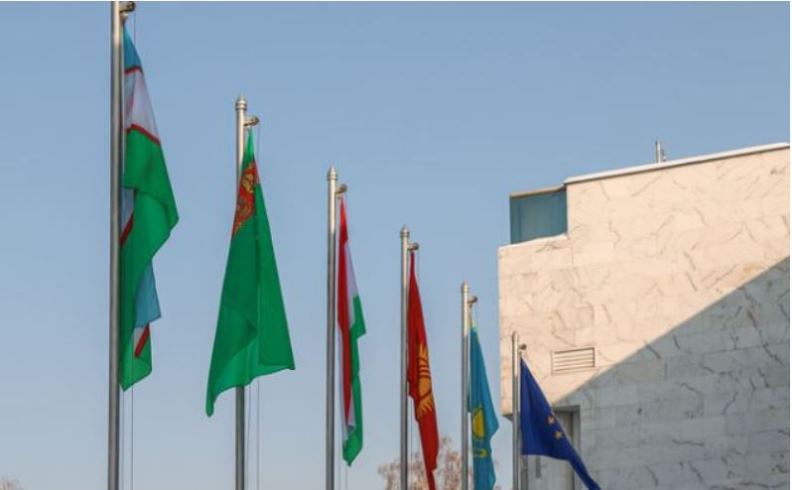
The European Union (EU) Delegation to Uzbekistan said on February 13 that the first EU-Central Asia summit will take place on April 3-4, 2025.
During the summit that will be chaired by Uzbekistan President Shavkat Mirziyoyev, the EU will affirm its commitment to scale up cooperation in areas of mutual interests, which include transport and digital connectivity in the region and with the EU, critical raw materials, economic and security cooperation, and energy transition.
“We are living in a world of disorder and fragmentation where the only viable solution for the EU is to build stronger partnerships to advance peace and prosperity. It is a multipolar world that requires greater and tailored engagement. The very first EU-Central Asia summit will solidify our commitment to work together for peace, security, and sustainable development, in full respect of international law,” said Mr. António Costa, President of the European Council
High-level relations between the EU and Central Asia have reportedly intensified over the past years, with two leaders’ meetings held in October 2022 in Kazakhstan and in June 2023 in Kyrgyzstan. Additionally, numerous ministerial-level discussions have taken place, with the most recent in Luxembourg in 2023, establishing a joint roadmap for deepening ties between the EU and Central Asia. The roadmap identifies concrete action points to enhance interregional dialogue, including the commitment to hold a summit, according to the EU Delegation to Uzbekistan.
The 20th EU-Central Asia Ministerial meeting will take place on March 4, 2025 in Ashgabat, Turkmenistan, and will also be dedicated to summit preparations.
In 2019, the EU adopted a new Strategy on Central Asia, which highlights the growing strategic relevance of the region for EU interests and builds upon the positive developments in regional cooperation over the years. The updated strategy aims to foster a stronger, modern and non-exclusive partnership with the countries of Central Asia so that the region develops as a sustainable, more resilient, prosperous, and closely interconnected economic and political space.
The EU is the second trading partner for the region, as well as the biggest investor with over 40% of the investment in the region originating from the EU. To further deepen bilateral ties, the EU has negotiated enhanced partnership and cooperation agreements (EPCAs) with all Central Asian countries, except Turkmenistan.