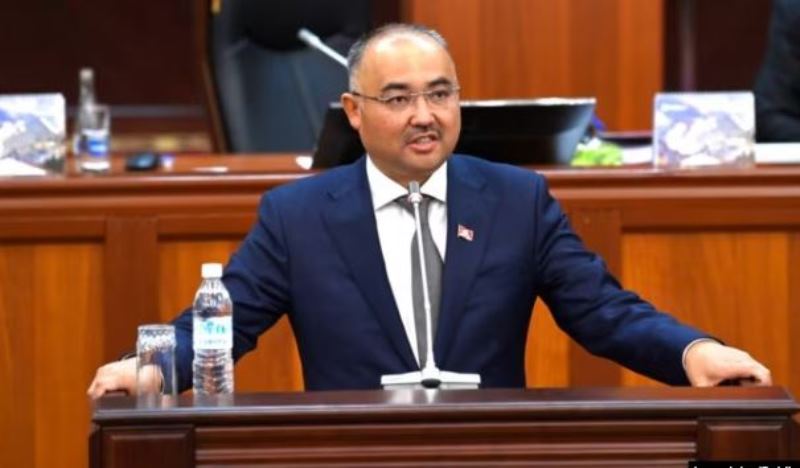
Journalist-turned-politician Nurlanbek Turgunbekovich Shakiyev has been a household name in Kyrgyzstan for more than two decades. The speaker of parliament recently announced that he had legally changed his last name to Turgunbek uuly, abandoning his Russified patronymic and surname.
"I did not come to this decision overnight. It has been a longstanding dream of mine," Turgunbek uuly wrote in a Facebook post in which he stressed the importance of national identity, language, religion, and traditions, Radio Liberty’s Kyrgyz Service reported on February 13.
On February 6, Kyrgyzstan's parliament adopted a bill promoting traditional Kyrgyz last names and "expanding the choice of surnames in line with Kyrgyz customs and cultural characteristics," according to its authors.
Styling surnames in line with national tradition became a popular trend in Kyrgyzstan and other Central Asian countries after the collapse of the Soviet Union in 1991.
The enthusiasm faded, however, as a widespread poverty in the region forced millions of Central Asians to migrate to Russia in search of work. Several migrants workers who spoke to RFE/RL said it was easier to then adopt Russified surnames.
The trend is making a comeback again, though, with some experts linking it to the changing mood following Russia's full-scale invasion of Ukraine in 2022, which many in the region oppose.
In the early 2000s, tens of thousands of Kyrgyz changed their last names, removing the Russian suffixes of -ov/-ev and -ova/eva for men and women, respectively, in favor or the Kyrgyz endings -uuly and -kyzy.
The new Kyrgyz bill offers multiple versions of patronymics and surnames styled in line with national customs, such as the unisex ending of -tegi, or the -din and -den suffixes for men's and women's last names, respectively.
The bill also says Kyrgyz citizens are free to choose Russified last names, should they prefer. Members of various ethnic groups are free to style their names according to their own national traditions.
Tajikistan is the only country in Central Asia that has officially banned Russian-style last names in 2016.
Dushanbe has also ordered its citizens to give their children "pure" Tajik first names, with the government even issuing a catalog of recommended first names for babies. The move has been widely seen as an effort to combat the growing popularity of Arabic and Islamic names.
Tajik President Emomali Rahmon changed his Russified last name in 2007, the only head of state in Central Asia to do so.