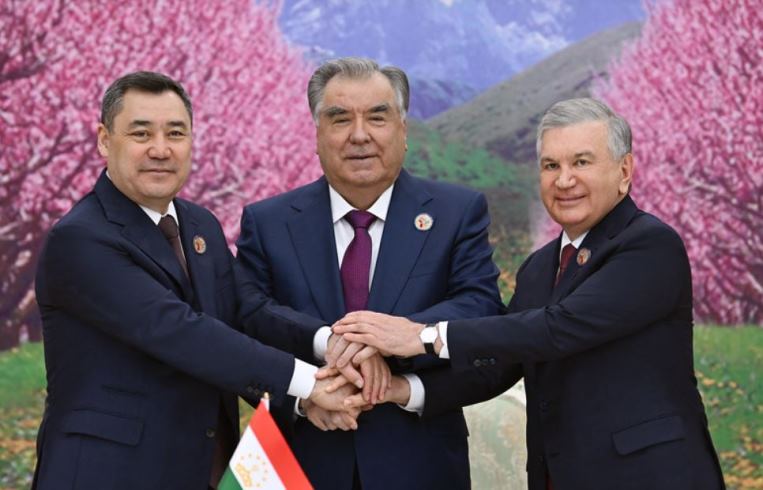
The Tajik president’s official website reports that after the conclusion of the trilateral negotiations, which took place in Tajik northern city of Khujand yesterday, the Treaty between Tajikistan, Kyrgyzstan and Uzbekistan on the Junction Point of the State Borders of the three countries and the Khujand Declaration on Eternal Friendship were signed.
Then the heads of state participated in the ceremony of the virtual opening of the symbolic stele (column) at the junction point of the state borders of Tajikistan, Kyrgyzstan and Uzbekistan.
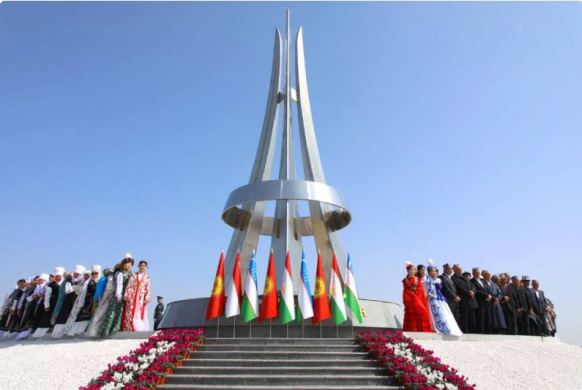
With the consent of the heads of state, the symbolic structure was opened in a solemn atmosphere by the responsible representatives of the parties.
Recall, this meeting was preceded by a meeting of prime ministers of the three countries ministers, which was held on January 8 this year.
The three countries’ prime ministers met at the junction where Kyrgyzstan’s Batken region, Tajikistan’s Sughd province, and Uzbekistan’s Fergana region come together. Qohir Rasoulzoda, the Prime Minister of Tajikistan, Adylbek Kasymaliyev, the head of the Cabinet of Ministers of Kyrgyzstan, and Uzbekistan’s Prime Minister Abdulla Aripov gathered in a tent that appeared to have been specifically constructed for the meeting.
The prime ministers of the three countries reportedly emphasized that the countries have great potential for strengthening cooperation in key areas such as trade, logistics, water and energy, and cultural and humanitarian ties. The statement also cited “the development of cross-border and interregional cooperation” as critical.
It is to be noted that following the 1991 collapse of the Soviet Union, Central Asia’s borders became international boundaries. As the newly independent states of the region strived to define themselves, and in particular establish their sovereignty, the crooked borders of the Fergana Valley became a point of contention, and violence.