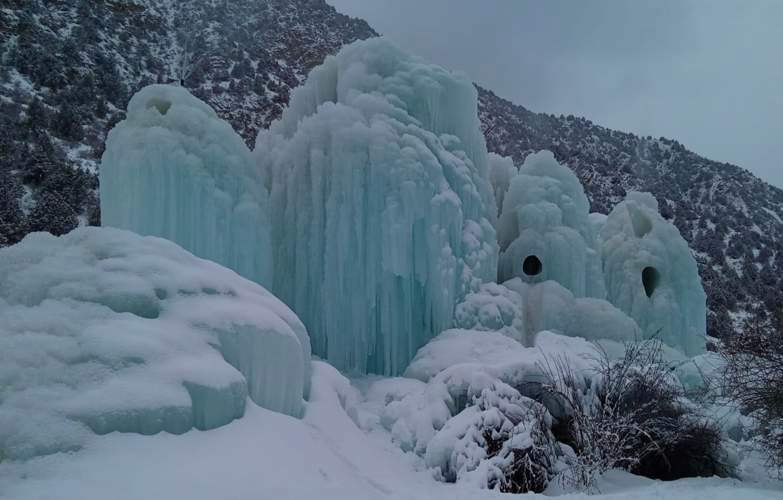
As Tajikistan faces rapid glacier loss due to climate change, experts are urging the country to adopt artificial ice towers, a water conservation method successfully tested in neighboring Kyrgyzstan.
Also known as “ice stupas,” these man-made glaciers store water in winter and release it slowly during dry months, providing a sustainable source for remote mountain communities. The technology was highlighted at the side session “Accelerating Global Action for Glacier Resilience” during the International High-Level Conference on Glacier Preservation, held in Dushanbe from May 29–31.
Kyrgyz success story
Anara Alymkulova, Executive Director of Kyrgyzstan’s Institute for Sustainable Development Strategy, described the rollout of artificial glaciers in her country. The first was reportedly built in 2022 in Jalal-Abad province with UN FAO support. By 2024, 10 more towers were installed, and Kyrgyzstan now has around 30, storing over 1.5 million cubic meters of winter ice.
How they work
Ice towers are created by spraying water into freezing air, forming vertical ice cones up to 50 meters high. A pipeline brings water from a spring to a vertical pipe where it freezes in layers. In warmer months, the melting ice provides fresh water for drinking and livestock. Each tower can store up to 50,000 cubic meters of water, and costs about $3,000–4,000 to build—an affordable solution with big impact for isolated communities.
Why Tajikistan needs them
Tajikistan has already lost 20% of its glacier volume and 30% of its glacier area over the past 50–60 years. The UN warns that Central Asia could lose more than half of its glaciers by 2050, threatening water and food security for over 64 million people—especially those in rural mountain areas.
This year, declared the International Year of Glacier Preservation at the initiative of President Emomali Rahmon, brought global attention to the crisis. More than 2,500 delegates from 80 countries attended the Dushanbe conference.
Scaling up the model
FAO and Kyrgyzstan’s Ministry of Water Resources have launched a new project to scale artificial glacier technology and implement an integrated water system called “Glacier – Reservoir – Farmer.”
Following a formal request earlier this year, FAO developed a guidance document for nationwide use. A symbolic project launch took place on April 29 in Bishkek.
These simple structures store winter water as ice for summer irrigation. A single glacier can support 300–500 hectares of farmland. FAO recommends adding small reservoirs and modern irrigation systems to maximize efficiency and minimize water loss—helping farmers improve yields and income.
Some of the first artificial glaciers in Kyrgyzstan were reportedly built in the Uzgen, Kochkor, and Aksy districts under various FAO projects. To date, the country already has over 30 artificial glaciers, which have proven highly effective and significantly eased the workload of local farmers.
Kyrgyzstan’s experience, including successful projects in Uzgen, Kochkor, and Aksy, demonstrates that low-cost, community-driven solutions like ice towers could be vital tools for Tajikistan and the broader region as climate pressures grow.