Dushanbe taxi drivers raise alarm over new regulations

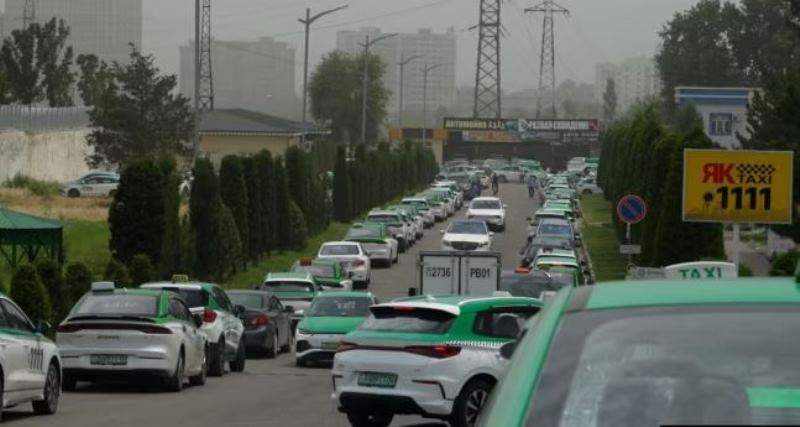
Taxi drivers in the capital are sounding the alarm over what they describe as unfair reforms after city authorities limited taxi licenses to only four companies. Previously, 12 companies operated in the city. Radio Liberty’s Tajik Service, known locally as Radio Ozodi, says drivers now say they are being forced to re-sign contracts with the […]

Asia-Plus

Taxi drivers in the capital are sounding the alarm over what they describe as unfair reforms after city authorities limited taxi licenses to only four companies. Previously, 12 companies operated in the city.

Radio Liberty’s Tajik Service, known locally as Radio Ozodi, says drivers now say they are being forced to re-sign contracts with the licensed companies, which charge significantly more — up to 100 somonis daily, regardless of whether a driver works that day.

Sohibnazar Nazarov, who took a bank loan to buy a car, says his former employer Yak Taxi shut down. He’s now required to join a new company, ‘80 00’, and pay a fixed daily fee.

“They sent us SMS messages saying the company closed.  We had to get documents proving we have no debts just to switch to ‘80 00’. Even if we don’t work, we pay 100 somonis. Most of us have loans and can’t keep up,” he told Radio Ozodi.

Previously, drivers paid about 10% of their income to taxi companies. Now, they say they must pay fixed fees, while still covering personal loans — often over 7,500 somonis per month.

“We can’t feed our families, buy anything for our kids. If they reduced the fee to 50 somonis, it would help. This is too much,” said Nazarov.

The city’s May 2 directive approved operations for Eco Taxi, Olucha-Avto, Koviyon, and Safo Taxi, authorizing each to run 3,000 vehicles.  Companies like Rakhsh Taxi and Talco-Persia were excluded.

Driver Bakhtiyor Ibrohimov says the rules are too rigid: “Even if you’re sick, you still owe 100 somonis. That’s what we’re told.”

Qudratsho Khazonov added: “We don’t know how to work anymore. Traffic police are taking all our documents.”

Transport authorities have not commented. Ownership of the newly licensed companies is also unclear.

In response to a formal inquiry, the national transport regulator said no companies had been banned and that the quota system is set by the city government. However, drivers report increasing pressure.

Drivers also face pressure to switch to electric vehicles under Dushanbe’s green transport policy.  In recent years, older cars were banned, and authorities now expect the entire fleet to transition to EVs.

As Dushanbe’s transport policy becomes increasingly centralized and demanding, taxi drivers warn that without relief, many of them will be driven off the road — not by competition, but by regulation.

Join us on social media!

Article translations:

Related Article

Оби зулол
Оби зулол

Most Read

Recent Articles

The only GPW veteran in Dushanbe allocated more than 80,000 somoni

The mayor's office of Dushanbe allocated him 25,000 somoni.

GITEX AI Kazakhstan 2026: how Almaty became the main AI hub of Central Asia

More than 300 companies and startups, over 200 speakers and 100 investors from 50 countries — the region is entering the global stage.

A trade and economic park to be built at the border junction of Tajikistan, Kyrgyzstan, and Uzbekistan

President of the Kyrgyz Republic Sadyr Japarov familiarized himself with the project.

A project to protect soil from degradation to be developed in Central Asia

The initiative is of great significance for the mountainous countries of the region, including Tajikistan.

Mudslide, death, and destroyed homes: hundreds of families in Tajikistan left homeless

A correspondent from "Asia-Plus" visited Kulob and spoke with the families of those who died and were affected by the disaster.

Spring 2026 bright event: new issue of VIPzone now on sale

This issue is about people and ideas that change everything: from business and investments to fashion, food, and urban environment.

Godfrey Sullivan: “Tajikistan is a promising market for Visa to develop digital payments”

The Vice President of Visa explained why Tajikistan is becoming a promising market for digital payments and how artificial intelligence is influencing the future of finance.

Seven students in Dushanbe were threatened with expulsion for arriving at universities in personal cars

The materials for each case have been sent to the Ministry of Education and Science for appropriate actions.

India’s blockchain push and lessons for the global south

The Indian Government has started pushing aggressively its agenda...

India’s blockchain push and lessons for the global south

The Indian Government has started pushing aggressively its agenda...