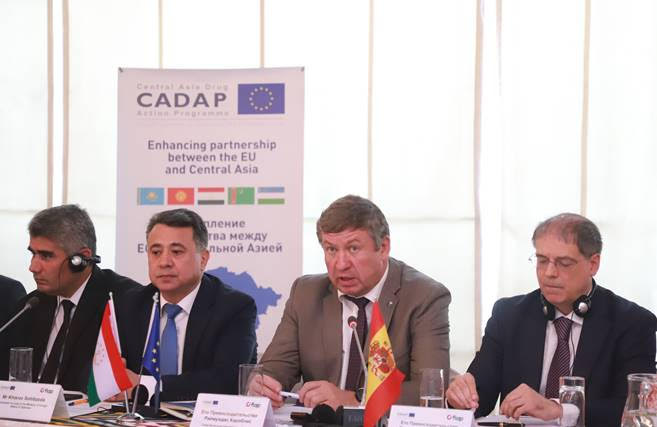
The fourth and final meeting of the Steering Committee of the 7th phase of the European Union-funded Central Asia Drug Action Program (CADAP) on July 3 brought together delegates of national beneficiary agencies from Central Asian countries – Kazakhstan, Kyrgyzstan, Tajikistan, Turkmenistan, Uzbekistan, representatives of the European Union, embassies and international organizations, international experts in the field of drug control and non-governmental organizations.
Press release issued by the EU Delegation to Tajikistan notes that during the meeting main results of the Program and future plans are being presented together with best practices and lessons learnt and also a constructive professional dialogue and panel discussions among experts and beneficiaries from Central Asian countries are being held.
Mr. Raimundas Karoblis, Ambassador of the European Union to Tajikistan: "The European Union has long supported Central Asia through initiatives like CADAP and BOMCA, achieving tangible results in border security, law enforcement, and health systems. However, as criminal networks and the synthetic drug threat evolve, our response must adapt — emphasizing intelligence sharing, innovation, and regional cooperation. We believe in a balanced approach that addresses public health, human rights, and social resilience. Drug addiction is a societal challenge, not just a law enforcement issue. The European Union remains committed to supporting accessible treatment, prevention, and community engagement, especially for youth and vulnerable groups. The fight against drugs requires trust, transparency, and solidarity — and the EU is proud to stand alongside Central Asia as a dedicated partner in building a safer, healthier, and more resilient future."
Mr. Khisrav Sohibzoda, Ambassador-at-Large of the Ministry of Foreign Affairs of Tajikistan: “CADAP program has been one of the key instruments of support for Central Asian countries from the European Union in the fight against drug threats, strengthening public health and protecting the most vulnerable categories of citizens for more than two decades. What is especially important is that CADAP allows us not only to exchange information, but also to solve complex problems covering both national and regional and transnational aspects. CADAP is deservedly considered a stable partner of our region. Thanks to this initiative, the Central Asian countries were able to strengthen national mechanisms, improve the legislative framework, introduce modern approaches to the prevention and treatment of drug addiction, and expand the human resources of specialized institutions.”
Mr. Luis Francisco Martinez Montes, Ambassador of Spain to Tajikistan highlighted the involvement of the Government Delegation for the National Plan on Drugs. “CADAP has played a key role in bringing Central Asia closer to European institutions ”, he emphasized.
CADAP is a long-standing partner of the Central Asian region and Tajikistan. Phase 7 included activities such as technical assistance in developing a roadmap to strengthen key national policy in monitoring, prevention and treatment aspects, assistance in developing, testing and implementing prevention training curricula, developing a roadmap to improve data collection, and preparing national reports on early warning systems.
To date, over the 5 years of implementation of Phase 7 of CADAP in Tajikistan: CADAP 7 strengthened the dialogue on national policy issues, which contributed to the development of more balanced drug policies, strategies and plans; CADAP 7 increased technical and institutional capacity, expanded regional cooperation and exchange of experience, and strengthened early warning mechanisms on new psychoactive substances by developing epidemiological surveys, guidelines and reports; CADAP 7 contributed to the development of cooperation between the state and civil society in the field of primary prevention through community initiatives; and CADAP 7 developed a Therapeutic Program for the Treatment of People with Substance Use Disorders for Healthcare Workers in the Republic of Tajikistan and a Protocol on Cooperation between Prison Staff and Civil Society Regarding People Who Use Drugs in the Penitentiary System.