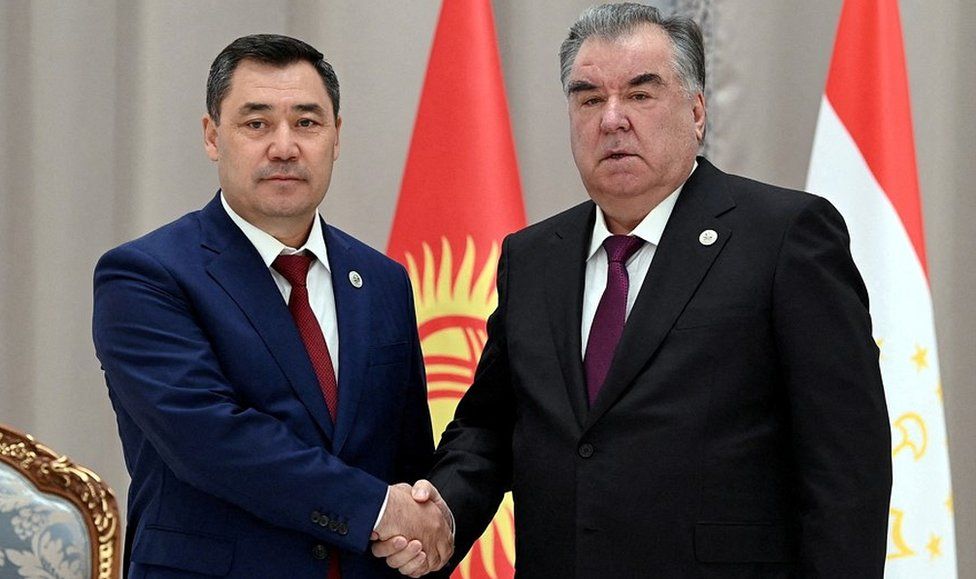
Tajikistan and Kyrgyzstan have agreed to establish a new Intergovernmental Council aimed at strengthening mutually beneficial cooperation across a broad range of sectors. The agreement was signed on July 8 in Dushanbe during the state visit of Kyrgyz President Sadyr Japarov.
According to the official document, published by Tajikistan’s Ministry of Justice, the Council is designed to foster deeper collaboration in trade, investment, industry, science and technology, and culture, based on the principle of mutual benefit.
The Council will be jointly chaired by the Prime Minister of Tajikistan and the Chairman of the Cabinet of Ministers of Kyrgyzstan. Its members will include representatives from relevant ministries, agencies, and, when necessary, industrial and business leaders from both countries, depending on the agenda.
The Council is empowered to propose initiatives for cooperation in any sector and may establish permanent or temporary working groups to support its functions. Regular meetings will be held annually, alternating between Tajikistan and Kyrgyzstan. Extraordinary sessions may be convened at the request of either party to address urgent matters. All decisions will be documented in Russian-language protocols signed by both chairpersons.
This move comes amid a significant thaw in bilateral relations, which had been strained by violent border conflicts in 2021 and 2022. Ties have steadily improved throughout 2025.
A key breakthrough occurred on February 21, when the heads of the two countries’ security services—Saimumin Yatimov and Kamchybek Tashiyev—signed a final agreement on border demarcation, ending a territorial dispute that had lasted more than three decades.
On March 13, Presidents Emomali Rahmon and Sadyr Japarov met in Bishkek to formalize a land-swap agreement and reopen border checkpoints that had been closed since the 2022 clashes.
Further progress followed on May 27, when the two sides held consular consultations in Dushanbe to discuss migration, citizen rights, and easing cross-border movement. On July 8–9, President Japarov paid a state visit to Tajikistan, resulting in the signing of 14 new bilateral agreements.
Following the talks, Rahmon and Japarov remotely inaugurated the newly re-opened “Tojvaron–Karamyk” border crossing point (BCP), a symbolic step toward reconciliation.
Trade between the two nations is also beginning to recover. After Kyrgyzstan unilaterally closed the border in April 2021, bilateral trade plunged from nearly US$40 million in 2020 to just US$12 million in 2024.
However, a two-way trade between the countries over the first five months of this year has valued at little more than US%6 million, which is 30 percent more than in the same period last year. This consisted of Tajikistan’s exports to Kyrgyzstan totaled US$1.3 million and Tajikistan’s imports from Kyrgyzstan worth US$4.7 million.