Kyrgyz parliament votes to disband ahead of early elections

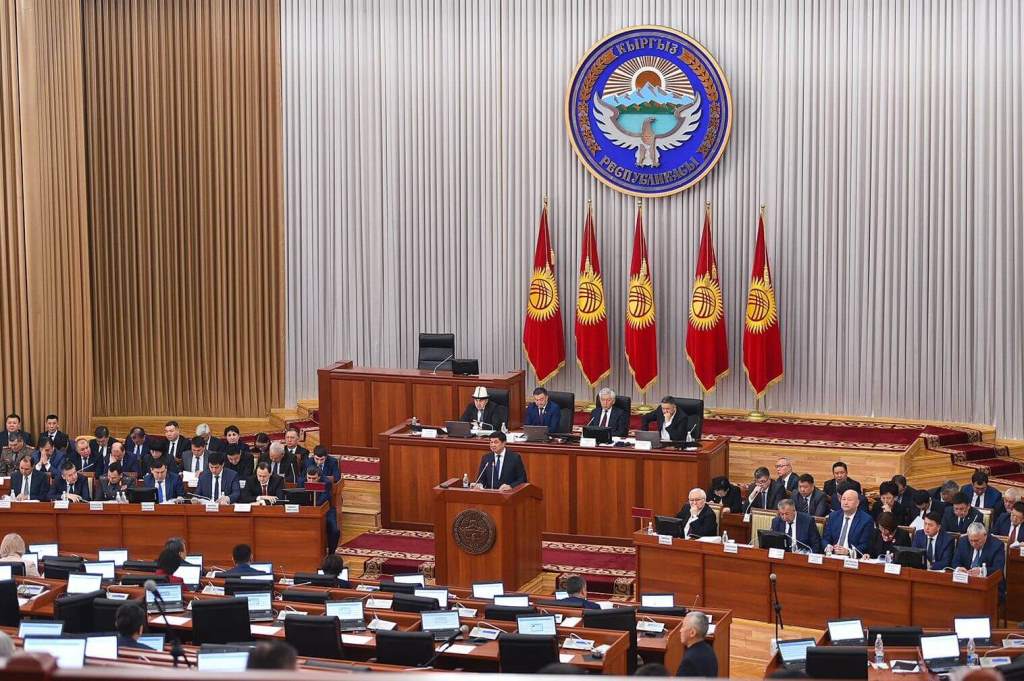
The Parliament of Kyrgyzstan (Jogorku Kenesh) has voted to disband itself, following a decision made by the members of the 7th convocation on September 25.  The Jogorku Kenesh’s press center says the move was approved during a parliamentary session, according to a statement from the parliament's press service. Ulan Primov, a member of parliament who […]

Asia-Plus

The Parliament of Kyrgyzstan (Jogorku Kenesh) has voted to disband itself, following a decision made by the members of the 7th convocation on September 25.  The Jogorku Kenesh’s press center says the move was approved during a parliamentary session, according to a statement from the parliament's press service.

Ulan Primov, a member of parliament who presented the proposal, explained that an initiative group of 32 deputies had suggested the voluntary dissolution of the current parliament.  He pointed out that the time gap between the presidential and parliamentary elections is relatively short, and for the sake of strengthening the political system and ensuring stability in the country, the group recommended that the parliament step down voluntarily.

“The initiative group believes that in order to enhance the political system and stability, it would be best to dissolve the current parliament ahead of schedule,” Primov said, also noting changes in the electoral law.

The decision was overwhelmingly supported, with 84 out of 89 present deputies voting in favor of dissolving the 7th convocation of the Jogorku Kenesh.

Under Kyrgyz law, President Sadyr Japarov is required to announce a date for early parliamentary elections within five days of the parliament’s dissolution.  Typically, the election date is announced no later than 90 days before the vote.  However, with early elections, this period is reduced by one-third, meaning that if the president signs the decree on September 26, the elections will be scheduled for November 26.

Earlier this year, in June, President Japarov signed a constitutional law that introduced changes to the parliamentary election system.  According to the new rules, the Jogorku Kenesh elections will be held in 30 multi-mandate constituencies, with three candidates winning seats in each constituency.  One seat in each district will be allocated for a gender quota, ensuring at least 30 women are represented in parliament.

Before approving the amendments, Japarov emphasized that the new system was “a suitable option for the Kyrgyz people,” stating that it would provide citizens with more choices and place the responsibility for selecting candidates directly on the voters.

Join us on social media!

Article translations:

Related Article

Оби зулол
Оби зулол

Most Read

Recent Articles

The only GPW veteran in Dushanbe allocated more than 80,000 somoni

The mayor's office of Dushanbe allocated him 25,000 somoni.

GITEX AI Kazakhstan 2026: how Almaty became the main AI hub of Central Asia

More than 300 companies and startups, over 200 speakers and 100 investors from 50 countries — the region is entering the global stage.

A trade and economic park to be built at the border junction of Tajikistan, Kyrgyzstan, and Uzbekistan

President of the Kyrgyz Republic Sadyr Japarov familiarized himself with the project.

A project to protect soil from degradation to be developed in Central Asia

The initiative is of great significance for the mountainous countries of the region, including Tajikistan.

Mudslide, death, and destroyed homes: hundreds of families in Tajikistan left homeless

A correspondent from "Asia-Plus" visited Kulob and spoke with the families of those who died and were affected by the disaster.

Spring 2026 bright event: new issue of VIPzone now on sale

This issue is about people and ideas that change everything: from business and investments to fashion, food, and urban environment.

Godfrey Sullivan: “Tajikistan is a promising market for Visa to develop digital payments”

The Vice President of Visa explained why Tajikistan is becoming a promising market for digital payments and how artificial intelligence is influencing the future of finance.

Seven students in Dushanbe were threatened with expulsion for arriving at universities in personal cars

The materials for each case have been sent to the Ministry of Education and Science for appropriate actions.

India’s blockchain push and lessons for the global south

The Indian Government has started pushing aggressively its agenda...

India’s blockchain push and lessons for the global south

The Indian Government has started pushing aggressively its agenda...