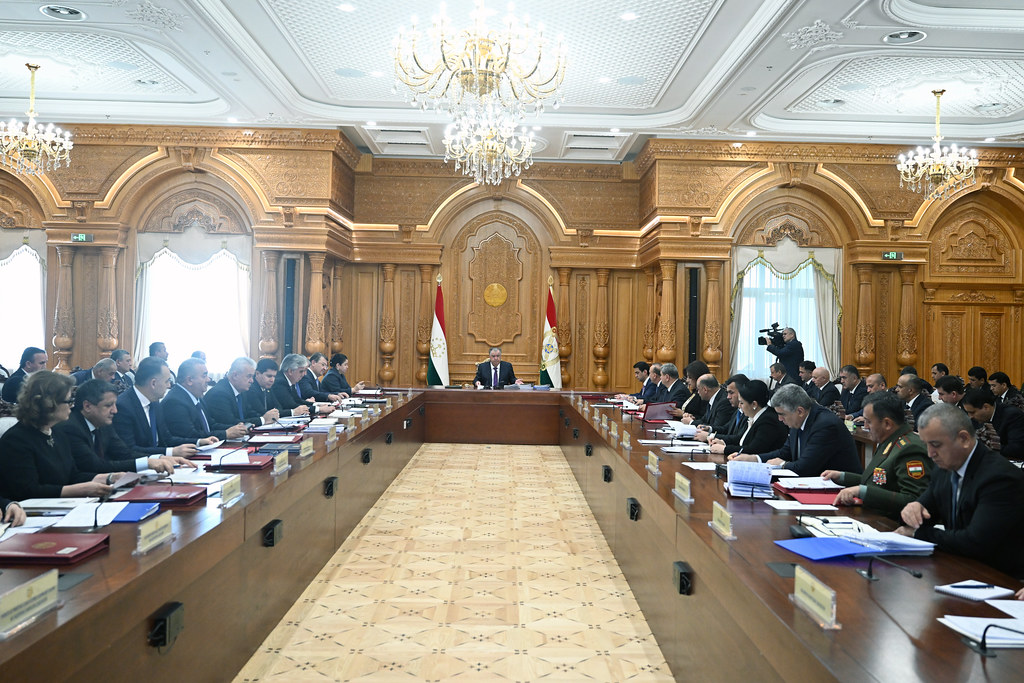
On September 29, a government session was held under the chairmanship of President Emomali Rahmon, who is also Head of the Government. During the meeting, several important reports and initiatives were presented, according to the Tajik president’s official website.
One of the main topics discussed was the State Program for the Development of New Irrigated Lands and the Restoration of Lands Excluded from Agricultural Use in Tajikistan for the period 2026-2030. The report was delivered by the Director of the Agency for Land Reclamation and Irrigation, Zafarbek Davlatzoda. The program aims to align with the National Development Strategy of Tajikistan until 2030 and the National Water Strategy until 2040. Its primary goal is to increase the area of new irrigated lands and restore agricultural lands that have been excluded from farming.
It was emphasized that the implementation of this program would result in the reclamation of 11,800 hectares of new land and the return of 16,750 hectares of land to agricultural use.
President Emomali Rahmon instructed the relevant authorities to approve the program and the action plan for its implementation.
Alongside this, the government also discussed several other strategic initiatives. These included the Inclusive Education Strategy in Tajikistan until 2045, presented by the Minister of Education and Science, Rahim Saidzoda; the Crafts and Professional Skills Development Strategy in Tajikistan until 2040, presented by the Minister of Labor, Migration, and Employment, Solehamo Kholmahmadzoda; and the Green Economy Development Strategy Action Plan in Tajikistan for 2023-2037 (Phase II: 2026-2028), presented by the Minister of Economic Development and Trade, Zavqi Zavqizoda.
The Inclusive Education Strategy aims to improve the social standing of children with disabilities by eliminating barriers to education and creating conditions for their full participation in society. The Crafts and Professional Skills Strategy focuses on strengthening the system of vocational training, developing professional skills among the workforce, and preparing labor resources for both domestic and international markets. The Green Economy Strategy aims to introduce institutional reforms, enhance natural capital use, attract investments, implement modern technologies, and strengthen international cooperation in green economy practices.
Following the discussions on these strategies and action plans, the government passed corresponding resolutions, assigning responsibilities for their timely and high-quality implementation.
Additionally, the meeting addressed key legislative matters, including the draft amendments to the Law on the State Budget for 2025, changes to the Healthcare Code of Tajikistan, and the Municipal Redevelopment Plan for the City of Khorog, the capital of the Gorno-Badakhshan Autonomous Region (GBAO).
At the end of the session, Emomali Rahmon assigned specific tasks to officials regarding the implementation of the discussed strategies, plans, and programs. He also instructed ministries and government agencies, as well as local authorities, to focus on attracting direct investments, improving infrastructure, rational energy use, and preparing for the celebrations of International Navrouz and the 35th anniversary of Tajikistan’s independence.