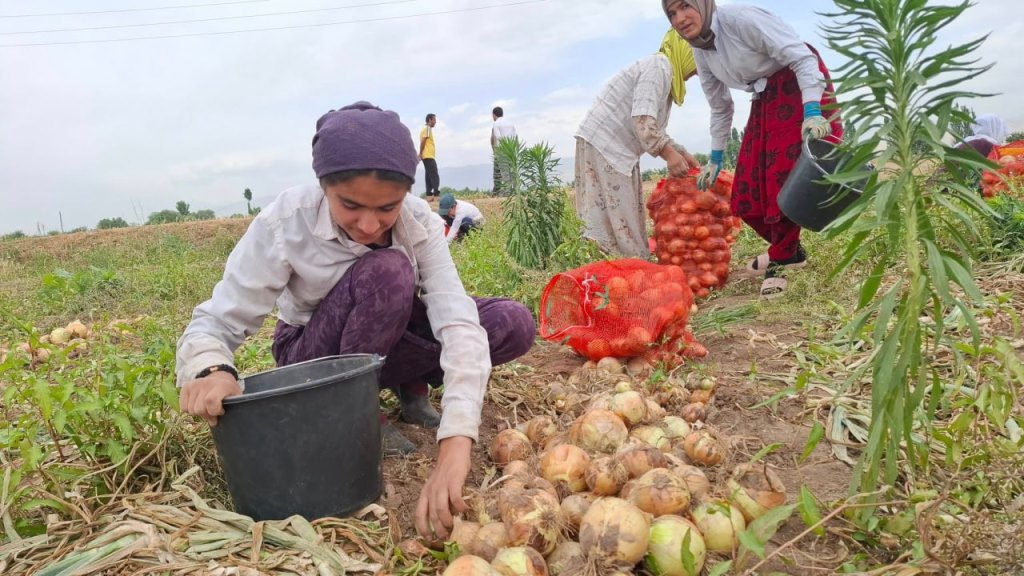
In the first eight months of 2025, Tajikistan produced over 500,000 tons of onions, marking a 27.3% decrease compared to the same period last year. The decline affected nearly all regions of the country, with the exception of the Sughd province, where production increased by 16.3% to 123,000 tons, according to the Agency for Statistics under the President of Tajikistan.
In the Gorno-Badakhshan Autonomous Region (GBAO), onion harvests totaled just 242 tons, a 10.1% decrease from the previous year.
In the Hisor Valley (districts subordinate to the center), production reached 66,000 tons, down by 20.1%.
The most significant decline occurred in the Khatlon province, where production fell by 37.7%, amounting to about 311,000 tons.
Onions become a risky crop
Experts and farmers attribute the decline to unfavorable climate conditions and reduced planting areas. The 2025 harvest suffered greatly from drought and water shortages, especially in Khatlon, traditionally the largest onion-producing region. An additional factor was the reduction in onion planting areas, as farmers scaled back due to low profitability in previous years, coupled with rising seed, fertilizer, and fuel costs.
Agricultural risks were exacerbated by plant diseases and a lack of pest control resources. The absence of modern storage and processing technologies also negatively impacted the overall harvest.
Why is the price of onions higher than last year?
With production down, onion prices have risen. In 2025, the price of onions increased by 23.5%, with the cost per kilogram reaching 3.00 somonis in September, compared to 2.60 somonis in September 2024. The price hike is driven by market shortages, seasonal fluctuations, and higher transportation costs. Increased fuel prices and logistics expenses further pushed up the final cost for consumers.
Tajikistan’s onion exports decline
Tajikistan’s onion exports have significantly dropped. According to data from the Customs Service, only 4,700 tons were exported between January and August 2025, compared to over 29,000 tons in the same period in 2024, generating $3.2 million. This decline is due to farmers shifting focus to the domestic market, where demand is higher and prices are more attractive.
Tajik onions are also losing competitiveness on international markets, as neighboring countries like Uzbekistan and Kazakhstan offer larger volumes at lower prices. Moreover, trade barriers and logistical challenges have further hindered exports.
The need for support
The decline in onion production highlights the importance of supporting farmers through subsidies, low-interest loans, and the introduction of modern storage and processing technologies. Without such support and efforts to find new export markets, Tajikistan will remain vulnerable to seasonal fluctuations and climate risks, which will continue to affect both prices and food security.