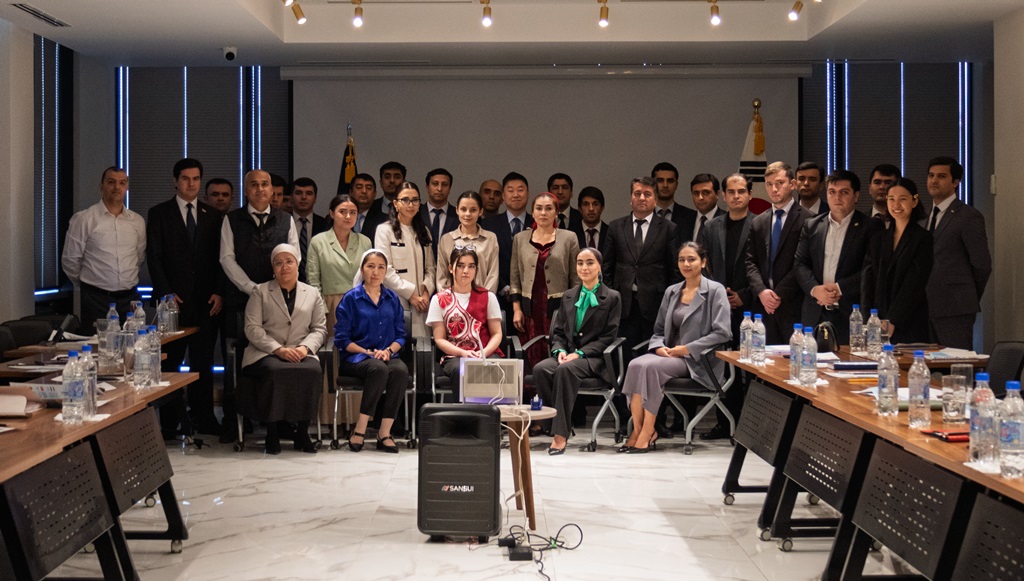
Several employees of the National Bank of Tajikistan (NBT) have completed advanced training on environmental risk oversight and green finance through the CIAT (Capacity Improvement & Advancement for Tomorrow) scholarship program, supported by the Korea International Cooperation Agency (KOICA). Their insights and achievements were shared during a seminar held at the Rumi Hotel in Dushanbe on October 17, 2025.
Once again, the CIAT program has helped civil servants from Tajikistan strengthen professional competencies while also gaining exposure to South Korean culture and development models.
The CIAT initiative supports knowledge exchange by offering both short-term training and long-term degree programs. This year, from September 7 to 20, NBT participants traveled to the Republic of Korea for a specialized course titled “Enhancing National Bank Supervision Capacity in Environmental Risks and Green Finance in Tajikistan (2025–2027)”.
Green vs sustainable finance: what’s the difference?
One of the program’s participants, Yusuf Saifiddinzoda, presented key takeaways from the training, including a comparative analysis of South Korea’s economy and energy sector. He noted that Korea’s trade volume accounts for 75–80% of its GDP, with exports valued at $684 billion and imports at $632 billion. Its top trading partners include China, the United States, Vietnam, Japan, and others.
Saifiddinzoda also clarified the distinction between green and sustainable finance. “Green finance refers to financial activities focused on environmental protection and climate change mitigation. Sustainable finance, on the other hand, encompasses broader investments — with green finance being one component,” he explained.
He emphasized the growing global importance of green finance due to escalating climate risks, the implementation of international agreements such as the Paris Accord, rising investor expectations, and the need for sustainable financial strategies.
Lessons from Korea’s financial oversight model
Parvina Qodirzoda, a leading specialist in NBT’s Financial Stability Department, presented an overview of Korea’s national banking supervision system. She highlighted the functions of the country’s central bank, which include currency issuance, monetary policy implementation, oversight of the payments system, economic research, and management of foreign reserves.
Qodirzoda compared Korea’s well-developed, multi-tiered regulatory system and its leadership in digital financial services to Tajikistan’s financial landscape. She noted that while Korea's financial system aligns with international standards, Tajikistan still faces key development challenges — including limited digitalization, low levels of financial literacy, and restricted financial inclusion.
Action plan for Tajikistan’s banking sector
NBT specialist Masrour Qurbonalizoda concluded the seminar by outlining a detailed action plan to modernize Tajikistan’s banking supervision framework. His recommendations included:
- Risk-Based Supervision (RBS) training and the use of financial modeling tools;
- Automation of oversight processes based on Korean best practices;
- Improvement of current banking management systems;
- Pilot implementation of new models, allowing early troubleshooting before full rollout;
- Strategic budgeting and KOICA partnership, to ensure sustained technology deployment;
- Career development and incentives, to retain trained personnel and mitigate brain drain.
Qurbonalizoda also warned of potential risks, including resistance to change, technical limitations, budget constraints, and the outflow of trained specialists to private banks or international organizations.
Supporting long-term capacity
In closing, KOICA Program Manager Kim Hee-eun reaffirmed the agency’s commitment to building Tajikistan’s institutional capacity. Graduates of the CIAT program, in turn, expressed their intention to apply their new knowledge to strengthen their respective sectors and support the country’s financial development.