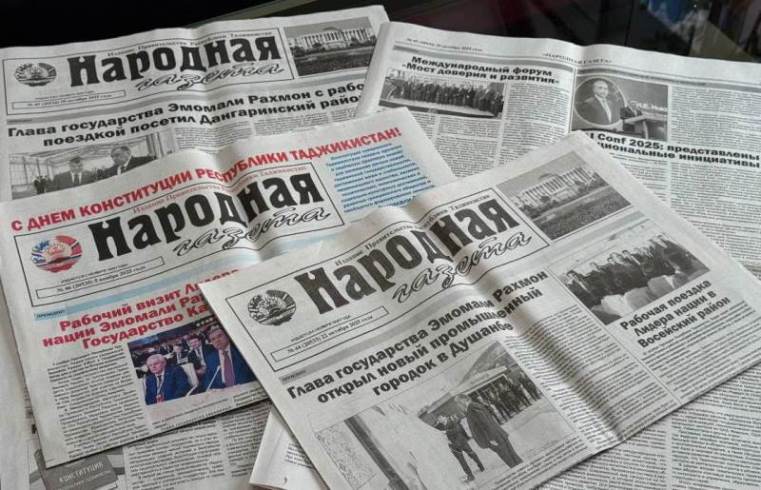
100 years of Tajikistan’s Narodnaya Gazeta: a century of national chronicle

In November 2025, Tajikistan’s Narodnaya Gazeta celebrates its 100th anniversary. Over the past century, it has evolved from a revolutionary party organ to the official government newspaper, maintaining its relevance in the country's media landscape.   From Sovetskiy Tajikistan to Narodnaya Gazeta The paper’s history began on November 7, 1925, with the first issue of […]

Asia-Plus

In November 2025, Tajikistan’s Narodnaya Gazeta celebrates its 100th anniversary. Over the past century, it has evolved from a revolutionary party organ to the official government newspaper, maintaining its relevance in the country's media landscape.


From Sovetskiy Tajikistan to Narodnaya Gazeta

The paper’s history began on November 7, 1925, with the first issue of Sovetskiy Tadzhikistan (Soviet Tajikistan) published in Dushanbe. The newspaper faced major challenges in its early years—shortages of type, paper, and trained journalists. Publication was suspended in 1927 but resumed in 1929 after Tajikistan became a union republic. Under editor Aron Glukhovskiy, the paper was revitalized and renamed Kommunist Tadzhikistana (Communist of Tajikistan).


Growth and challenges

With the launch of Printing House No. 1 and the construction of a dedicated editorial building in the 1930s, the paper gained a permanent home for the next 60 years. Yet political repression also touched its ranks: Glukhovskiy was arrested and later rehabilitated, returning to the editorial team. Despite difficulties, the paper persevered.

A major renaissance came in the 1970s–80s under editor Boris Pshenichny. The newspaper expanded its content, increased circulation, and earned numerous awards, including the Order of the Red Banner of Labor.


The turbulent 1990s

After the collapse of the Soviet Union, the transition to a market economy hit the newspaper hard. When Vladimir Vorobyov took over as editor-in-chief in 1994, the paper faced financial collapse, staffing shortages, and mounting debts. Recovery came through strong team effort and strategic negotiation. In 1998, Narodnaya Gazeta became the official print organ of the Government of Tajikistan.


A centennial legacy

From its roots as a party newspaper to its current role as a state publication, Narodnaya Gazeta has been a steadfast chronicler of the nation's history. Today, it continues to report on major national events with a commitment to professional journalism.

We extend our congratulations to the editorial team and wish the paper continued success, unity, and loyal readership. May the strength of its history be matched by its future.

Join us on social media!

Article translations:

Related Article

Оби зулол
Оби зулол

Most Read

Recent Articles

The only GPW veteran in Dushanbe allocated more than 80,000 somoni

The mayor's office of Dushanbe allocated him 25,000 somoni.

GITEX AI Kazakhstan 2026: how Almaty became the main AI hub of Central Asia

More than 300 companies and startups, over 200 speakers and 100 investors from 50 countries — the region is entering the global stage.

A trade and economic park to be built at the border junction of Tajikistan, Kyrgyzstan, and Uzbekistan

President of the Kyrgyz Republic Sadyr Japarov familiarized himself with the project.

A project to protect soil from degradation to be developed in Central Asia

The initiative is of great significance for the mountainous countries of the region, including Tajikistan.

Mudslide, death, and destroyed homes: hundreds of families in Tajikistan left homeless

A correspondent from "Asia-Plus" visited Kulob and spoke with the families of those who died and were affected by the disaster.

Spring 2026 bright event: new issue of VIPzone now on sale

This issue is about people and ideas that change everything: from business and investments to fashion, food, and urban environment.

Godfrey Sullivan: “Tajikistan is a promising market for Visa to develop digital payments”

The Vice President of Visa explained why Tajikistan is becoming a promising market for digital payments and how artificial intelligence is influencing the future of finance.

Seven students in Dushanbe were threatened with expulsion for arriving at universities in personal cars

The materials for each case have been sent to the Ministry of Education and Science for appropriate actions.

India’s blockchain push and lessons for the global south

The Indian Government has started pushing aggressively its agenda...

India’s blockchain push and lessons for the global south

The Indian Government has started pushing aggressively its agenda...