Tajikistan expands pomegranate plantations amid rising yields

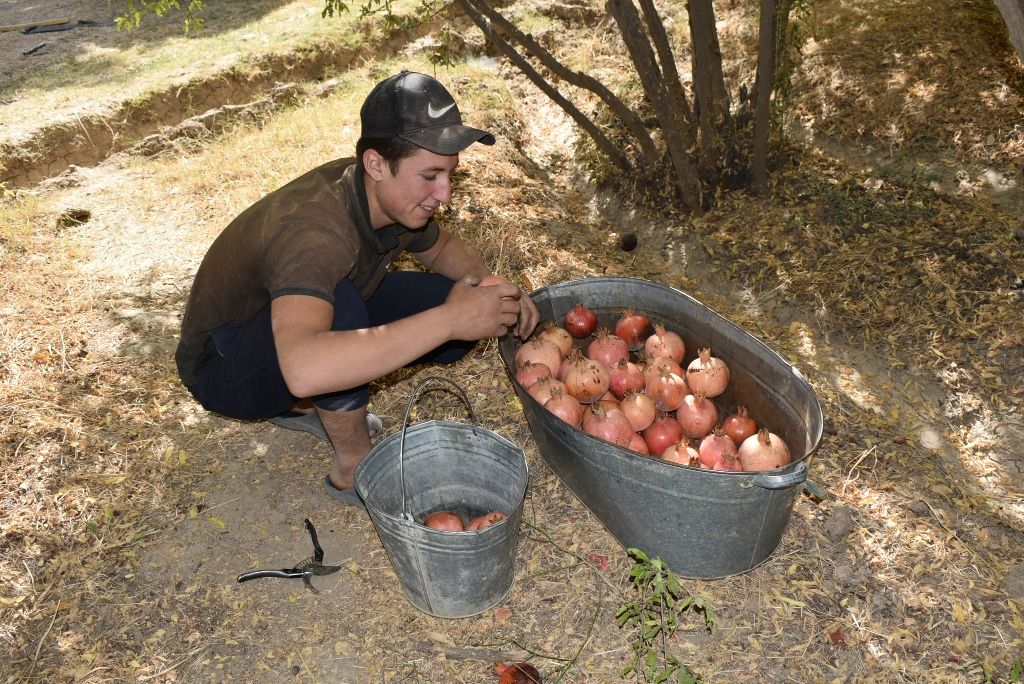
Tajikistan is rapidly expanding its pomegranate production, with plantation areas now covering around 2,700 hectares, according to the Institute of Botany, Plant Physiology and Genetics of the National Academy of Sciences. Over half of these orchards have been newly established in recent years, with production expected to increase significantly in the next two to three […]

Asia-Plus

Tajikistan is rapidly expanding its pomegranate production, with plantation areas now covering around 2,700 hectares, according to the Institute of Botany, Plant Physiology and Genetics of the National Academy of Sciences. Over half of these orchards have been newly established in recent years, with production expected to increase significantly in the next two to three years.

Currently, the annual harvest stands at approximately 18,000 tons. Experts credit this growth to favorable climate conditions and targeted government support for the horticulture sector.

“Pomegranates are not only a valuable food product, but also have medicinal properties and are gaining attention as a component of ecotourism. The government is actively promoting the expansion of plantations and improvements in product quality,” the institute noted.

Pomegranates have been designated a priority subtropical crop under the national Horticulture, Viticulture, and Citrus Development Program for 2025–2029. The program recommends region-specific cultivation of adapted varieties:

·         In the Gorno-Badakhshan Autonomous Region (Darvoz and Vanj districts), varieties like “Muloimdona” and “Surkhanor” are recommended;

·         In Khatlon Province — “Turushmazza,” “Shirindona,” “Surkhanor,” and “Muloimdona”;

·         In Sughd Province — “Muloimdona,” “Shirindona,” and “Surkhanor.”

The largest pomegranate orchards are located in Khatlon’s Nurek, Dousti, Qubodiyon, and Shamsiddin-Shohin districts, with smaller-scale cultivation in the Hisor Valley and Sughd province.

A subtropical research station in Khatlon’s Jaloliddin-Balkhi district is developing new varieties, including seed-soft and high-export-potential cultivars.

Still, experts say the industry’s potential remains underutilized. Average yields in Tajikistan are around 20 tons per hectare, while leading pomegranate-producing countries like Iran, Israel, and Turkey often exceed 60 tons per hectare.


Join us on social media!

Article translations:

Related Article

Оби зулол
Оби зулол

Most Read

Recent Articles

India’s blockchain push and lessons for the global south

The Indian Government has started pushing aggressively its agenda of embracing blockchain technology, and the same has received a new lease of life with...

India’s blockchain push and lessons for the global south

The Indian Government has started pushing aggressively its agenda...

25 Years in Touch: On Generation Change, “Digital” and “Invisible” Work

In its 25th anniversary year, "MegaFon Tajikistan" summarizes its...

The number of entrepreneurs in Tajikistan increases by 4.3%

The number of entrepreneurs operating under a patent is increasing the fastest.

Trump announces “very good” talks with Iran and the possibility of a quick agreement. Tehran did not comment on this

The President of the United States claims that Tehran has agreed to the US demand to abandon the development of nuclear weapons.

Police report the discovery of the remains of a man who had been missing since December 2025

A friend of the murdered person has been detained on suspicion of particularly brutal murder.

Residents of a settlement in Sughd: “Afghan refugees have disappeared from the Dehmoy jamoat”

Earlier, a citizen of Afghanistan was detained on charges of murdering a resident of Khujand.

In Russia, it was proposed to revoke residence permits and temporary residence permits from migrants who do not work for more than two months

During January-March 2026, 90% more residence permits were revoked from migrants in the country compared to the same period last year.

From reach to influence: why advertising no longer works by old rules discussed in Dushanbe

Market research forces a complete reconsideration of the advertising budget allocation strategy.