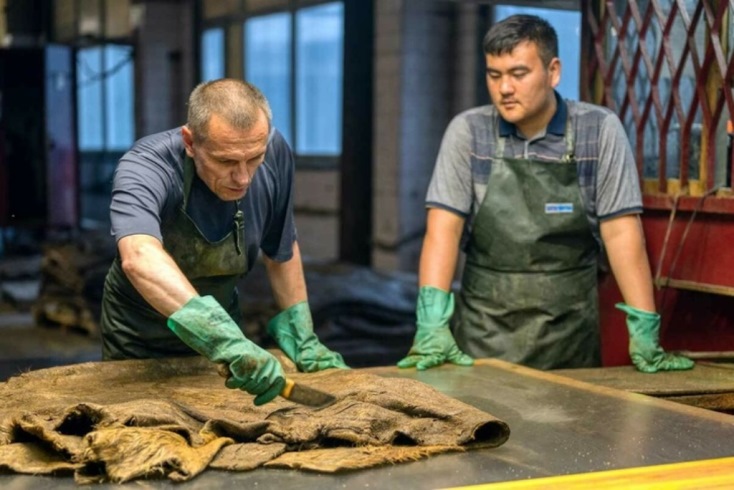
Only 1.0 percent of the leather Tajikistan produces is processed into manufactured goods in Tajikistan, while the remainder is exported for manufacturing outside the country, mainly to China. Despite having significant potential in the leather industry, the country remains an exporter of semi-processed raw materials, and finished products such as shoes, clothing, and accessories are almost entirely imported.
The main reasons for this situation are outdated technologies, a lack of investment, and weak government support, leading to annual losses of millions of dollars and job opportunities.
Historical context: decline after the collapse of the Soviet Union
During the Soviet era, Tajikistan had a developed leather and footwear industry. Factories in Dushanbe and Khujand processed up to 150 million square decimeters of leather per year, supplying the local population with footwear and leather goods and exporting products to other Soviet republics. However, after the collapse of the Soviet Union, these enterprises shut down, and the industry fell into decline.
Today, Tajikistan produces 1.5–1.7 million hides annually, but only 5,000–6,000 are processed, less than 1%. The vast majority of the raw material is sent to China, limiting opportunities for the development of domestic production.
Issues with processing and export
The lack of modern processing facilities for leather and its further use in the production of footwear and accessories remains one of the main reasons why Tajikistan does not develop domestic leather processing. In 2023–2024, the export of tanned leather amounted to $5.2–5.3 million, but the share of finished products was minimal — only a few thousand dollars.
In 2025, the situation did not improve: leather worth $2.46 million was exported, while the export of finished products was practically nonexistent. This highlights the raw-material nature of the industry and its dependence on external markets.
What is needed for industry development?
Despite attempts to change the situation, Tajikistan has not been able to achieve its goals. The Full Livestock Raw Material Processing Program, completed in 2015, set objectives to attract investments and increase domestic processing volumes, but these were not fulfilled.
The Industrial Development Strategy until 2030 calls for a shift from raw material exports to the production of finished goods, but these plans remain unimplemented.
To turn the situation around, Tajikistan needs to modernize its enterprises, attract investment, and create a cluster model that integrates raw material producers with processors. This will not only improve leather processing but also reduce dependence on the export of semi-processed raw materials.
Problems with government support and programs
After the completion of the livestock raw material processing program in 2015, no new specialized programs for the leather industry were developed. Requests to Tajikistan's Ministry of Industry and New Technologies remain unanswered. This indicates that the development of the leather industry is not receiving the necessary attention, despite its significant potential.