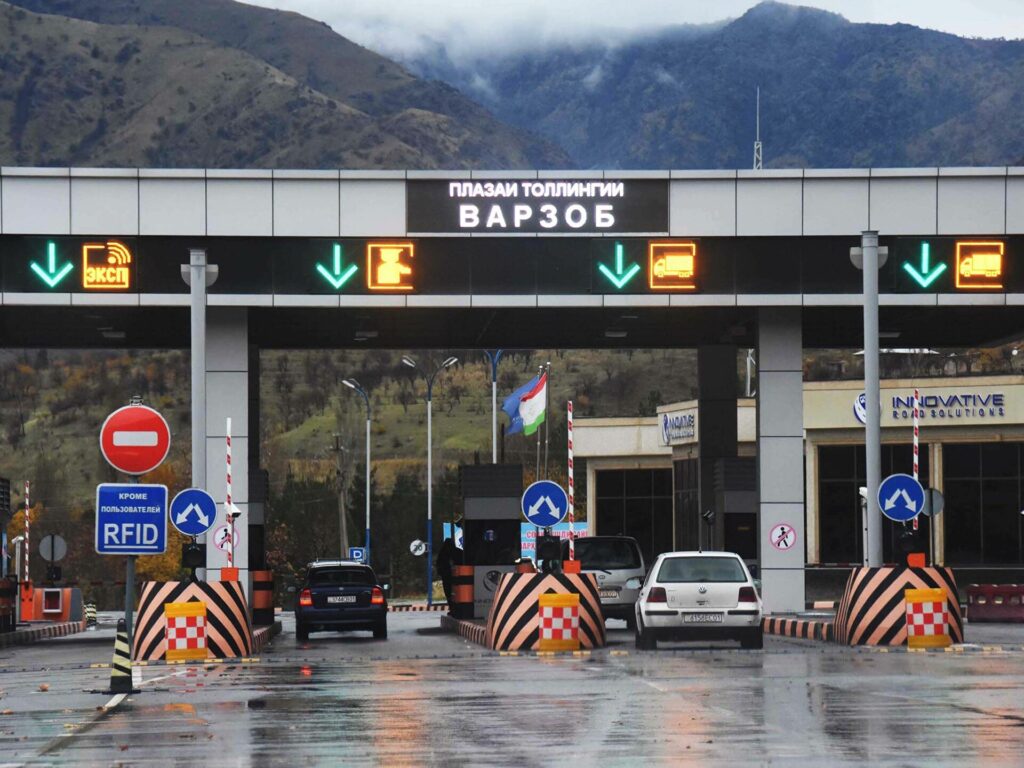
Exactly 16 years ago, on April 1, 2010, the first sections of the highway Dushanbe – Khujand – Chanak became toll roads after complete rehabilitation. We decided to find out how the cost of travel on this road has changed since then, and in which countries of Central Asia and Russia such practices exist.
The management of toll road infrastructure in Tajikistan is carried out by the “Branch of the International Company Innovative Road Solutions in the Republic of Tajikistan” based on a concession agreement with the government. According to official data, the company was registered in 2009 in the British Virgin Islands.
To rehabilitate the Dushanbe – Khujand – Chanak highway, the government of Tajikistan attracted a loan from the Chinese Exim Bank amounting to about $300 million.
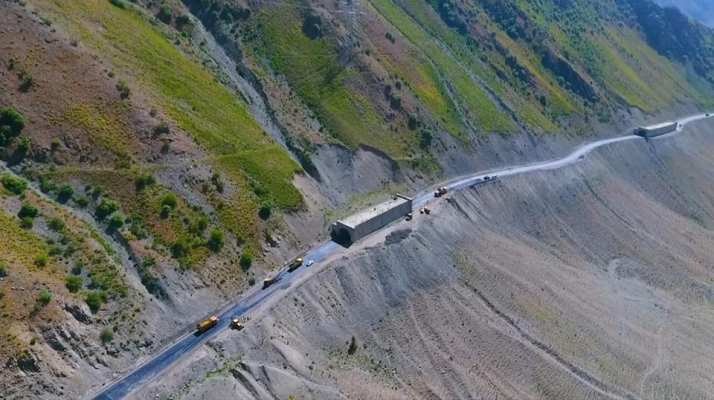
The first sections of the road, located in the Varzob district, became toll roads on April 1, 2010. Subsequently, the payment system was expanded, and six toll collection points appeared along the highway:
– “Varzob” — 63.3 km
– “Gushary” — 41.27 km
– “Shakhristan” — 41.44 km
– “Istaravshan” — 66.27 km
– “Dehmoy” — 65.6 km
– “Chorukh” — 60 km
The total length of the toll section is about 338 km.
Road users are divided into four categories. The first category includes passenger cars, minibuses, and trucks with a carrying capacity of up to 2 tons.
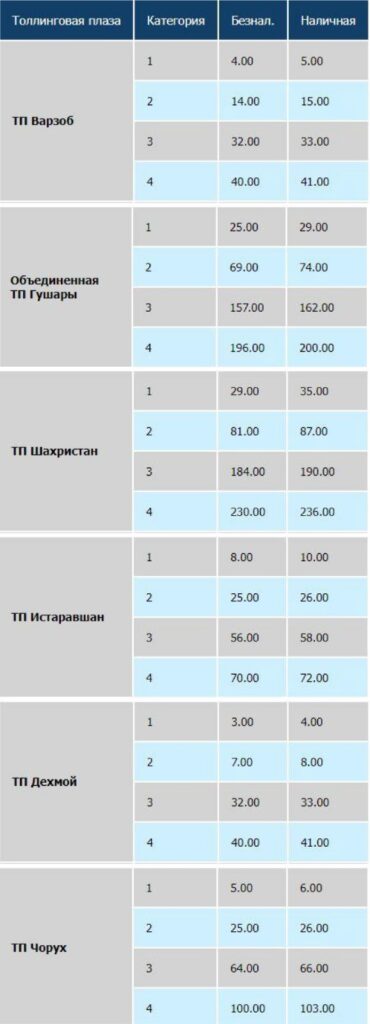
The standard toll rates for traveling on sections of this road are set as follows:
A system of discounted fares is provided for residents of settlements located along the highway.
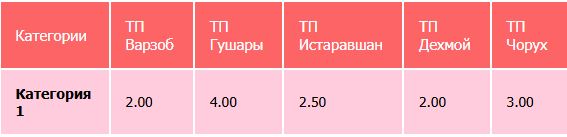
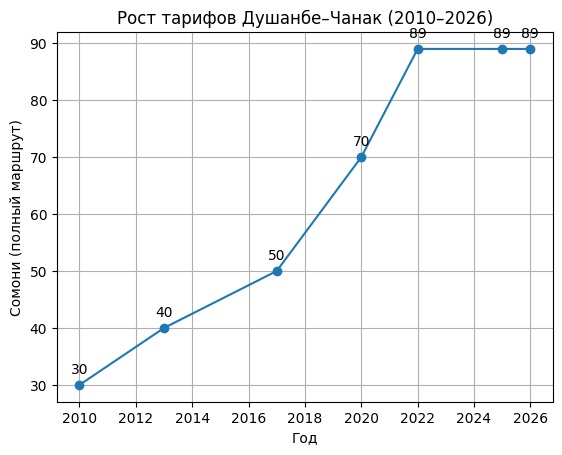
The rates for users in this category have increased almost threefold: from 30 somoni on April 1, 2010, to 89 somoni on January 1, 2022. Over the past three years, the cost of travel has remained unchanged.
What about the neighbors?
Tajikistan remains the first country in Central Asia to implement a toll road system.
Kazakhstan began developing toll roads later – the section Astana – Shchuchinsk opened in 2013. However, over the years, the country has significantly outpaced the region in scale: today there are 12 highways with a total length of about 4,900 km.
The average toll cost for passenger cars in Kazakhstan is significantly lower than in Tajikistan – around $0.2–0.3 per 100 km. The cost of traveling on the Dushanbe-Chanak road for this category of users is approximately 26.3 somoni ($2.7).
In Uzbekistan, toll roads are planned and partially implemented, but the system is still in development. In recent years, authorities have begun projects for the construction of the first toll highways (e.g., Tashkent – Samarkand). However, a full-fledged network does not yet exist.
Kyrgyzstan is also considering the possibility of introducing toll roads, but the system has not yet been launched in practice. There are also no such roads in Turkmenistan.
In Russia, the first toll road appeared back in 1999. Today, the network of toll roads is actively developing and already exceeds 3,000 km. The main operator is the state company “Avtodor.”
The cost of travel here is significantly higher than in Central Asia. On average, drivers of passenger cars pay about $3–5 per 100 km, and on certain sections (e.g., high-speed roads M-11 or M-12) the rate can be even higher depending on the time of day and traffic congestion.
At the same time, toll roads in Russia are characterized by high-quality pavement, developed infrastructure, and allow for significant time savings.
Do income levels match expenses?
Meanwhile, one of the key factors in the implementation of toll roads remains the income level of the population.
According to the latest available official data, the average salary in the region is:
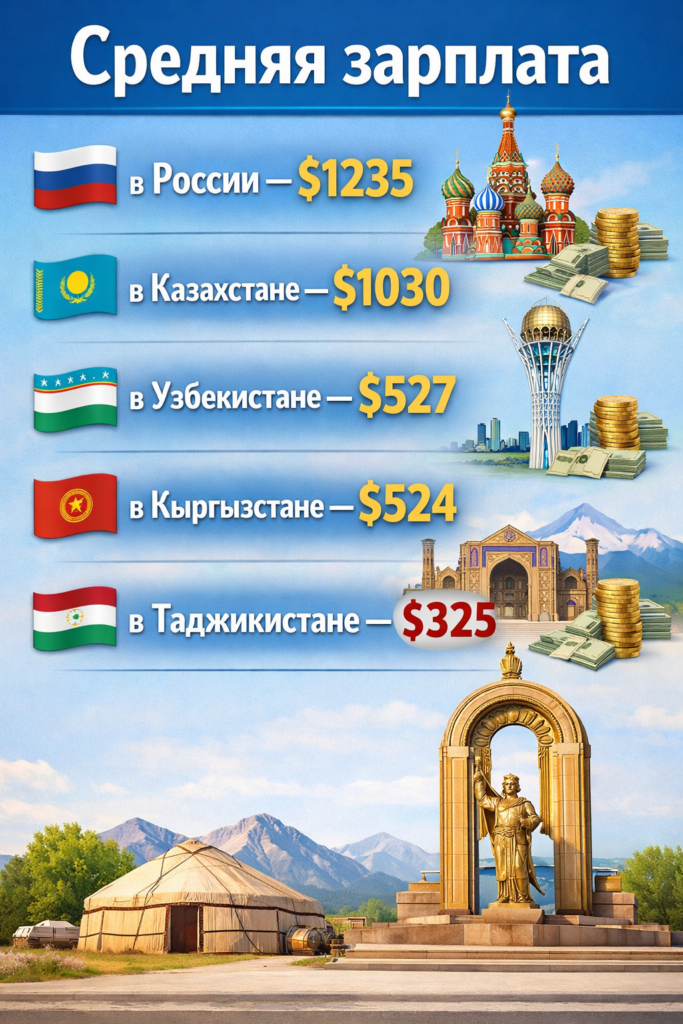
Data for Turkmenistan is unavailable in open sources.
Moreover, an important condition for the introduction of toll roads is the presence of alternative free routes, which corresponds to international practice.
No alternatives exist for the Dushanbe – Chanak highway.
Most of the toll highways in Kazakhstan have alternative roads.
According to Russian legislation, the decision to use a highway or its section on a toll basis can only be made if there is an opportunity for alternative free travel on a public highway.