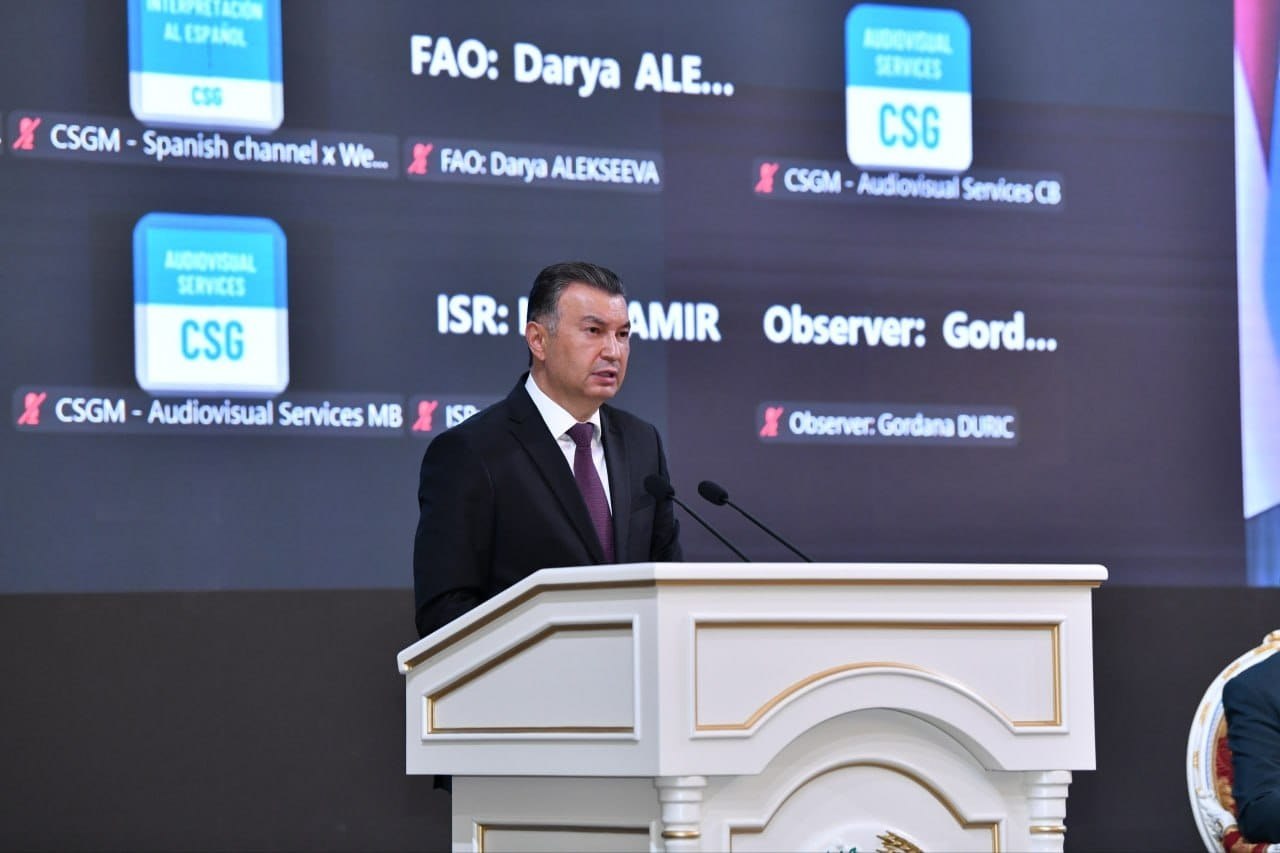
In a statement delivered at the opening of the FAO regional conference in Dushanbe, Tajikistan’s Prime Minister Qohir Rasoulzoda noted on May 11 that the country’s economy and agriculture are growing, but climate change, water scarcity, and ecosystem degradation pose new threats to the region.
The 35th Regional Conference of the United Nations Food and Agriculture Organization for Europe reportedly brought together representatives of the countries in the region, international organizations, experts, and partners in the fields of agriculture, food security, and sustainable development.
Tajik PM, in particular, stated that the country has achieved significant economic results over the past ten years.
“If you look at the figures of the last decade, you can clearly see the scale of our macroeconomic resilience and the correctness of the chosen strategic course,” said Qohir Rasoulzoda. “During this period, Tajikistan’s GDP has grown 3.4 times, and the monetary income of the population has increased 6 times. These achievements have helped reduce the poverty rate to 19% and increase the average life expectancy to 77 years.”
“These fundamental economic achievements have allowed us to address the main social task — to reduce the poverty level to 19 percent and increase the average life expectancy of our citizens to 77 years. Agriculture has become a reliable driver of this growth, demonstrating nearly a doubling in production volumes over the past five years,” the Prime Minister continued.
He emphasized that agriculture remains one of the main sectors of the country’s economy. It provides employment for a significant part of the population and makes an important contribution to GDP.
“We have set ambitious sectoral goals: annual industrial production growth should be 20 percent, paid services — 11.7 percent, agriculture — 8.5 percent. Agriculture remains the backbone of our economy, providing employment for more than 60 percent of the population and forming a quarter of the gross domestic product,” Qohir Rasoulzoda added.
Speaking about challenges, he noted that water, energy, food, and ecosystems are closely interconnected. However, climate change, population growth, infrastructure wear, and competition for resources increase pressure on agriculture.
According to Rasoulzoda, this problem is particularly acute in Central Asia, where the agricultural sector largely depends on irrigation. He pointed out the risks associated with glacier melting, transboundary water resources, and the development of hydropower.

The Prime Minister also reported that almost 85% of water use in Tajikistan is attributed to agriculture.
“We have set a major goal: to implement water-saving technologies on 50 percent of irrigated land by 2030. Active work is underway in Tajikistan to strengthen the food system. The development of small and medium-sized farms is supported, which play an important role in ensuring local food security. Special attention is paid to the development of livestock, poultry farming, and the processing industry,” said Qohir Rasoulzoda.
FAO Director-General Qu Dongyu urged countries in the region to cooperate more closely.
“Issues such as climate change and economic crises have no borders, and we must address them together,” said Qu Dongyu.
He emphasized that extreme weather — from droughts to floods — requires new approaches to agriculture and food security.