Following the introduction of temporary profit caps, meat prices in Dushanbe have stabilized. However, imported products now dominate market stalls, while locally produced meat is virtually absent due to its high production cost. A report from the “Sakhovat” market shows how beef prices are formed, what penalties vendors may face, and why regulation does not always solve the problem of expensive meat.
Where is local meat? What is being sold in the capital’s bazaars
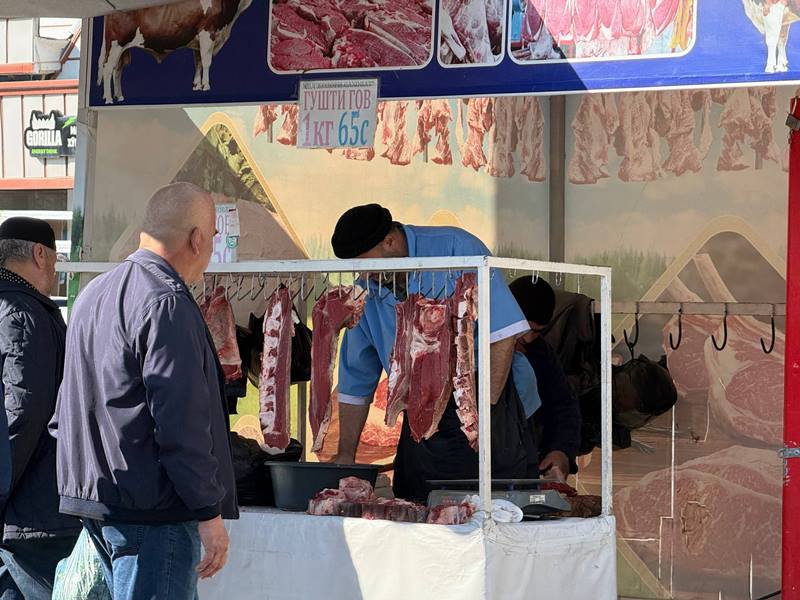
A week after the start of the month of Ramadan, we visited Dushanbe’s “Sakhovat” bazaar to find out whether meat prices had changed. At the very first stall, we saw that beef was selling for 65 somoni per kilogram, while lamb cost 75 somoni. Nearby stalls displayed the same prices. Vendors уточняют: the meat is imported from Belarus.
In the adjacent row, the situation is similar. Price differences are minimal: in some places beef costs 65 somoni, in others 67. Lamb averages 75 somoni per kilogram. At least at the time of our visit, there had been no sharp increase.
Traders say that Belarusian beef comes in several grades. The meat priced at 65 somoni is the cheaper option.
“This meat is not as tasty as that from our local cattle,” one vendor admits.
According to him, after defrosting it is harder to fry: it loses some of its juices and becomes less succulent, making it less suitable for steaks. However, it works well for minced meat—used for sambusa, manty, cutlets, and meatballs.
The seller compares the difference to chicken: “Have you tried store-bought drumsticks and meat from a домашняя chicken? The difference is about the same.”
Beef priced at 75 somoni, vendors say, is noticeably better in quality. This is also Belarusian meat, but of a different grade.
“The cattle were slaughtered there in Belarus by our entrepreneurs,” the trader explains.
The difference is visible in appearance: the cheaper meat is bright red, while the 75-somoni beef is darker and denser in structure, closer in color to local beef.
We visited around ten stalls at the “Sakhovat” market, and the same pattern repeated everywhere: prices were identical.
One grade of beef sells for 65 somoni, while the higher-quality option costs 75.
At the same time, we did not find any local meat on display—neither beef nor lamb. Vendors explain this in economic terms: the production cost of domestic beef exceeds 80 somoni. Selling it for less would mean operating at a loss, while charging more, they say, risks fines.
One trader adds that the price is made up of the purchase cost, transportation expenses, rent, electricity, and losses during butchering.
“We cannot simply lower the price,” he says. According to his estimate, the profit amounts to 5–10 somoni per kilogram.
Buying imports, waiting for local supply
Customers approach the stalls, внимательно inspecting the meat: some bargain, others silently take out their money. A small queue forms at one pavilion. A woman in a dark headscarf chooses a cut with less fat and says that during Ramadan, meat is purchased more often—especially for iftar.
“For now, the price is holding,” she notes, “but it usually rises before the holidays.”
Nearby, a middle-aged man asks for two kilograms of beef at 65 somoni. He admits that he prefers local meat, but it is currently unavailable in the market and is also more expensive.
“Of course, local is better and fresher. But if it’s not supplied and the price is high, we have to buy Belarusian,” he says.
Buyers note that this year they are watching prices especially closely. Demand traditionally rises during Ramadan, and people fear price increases. Some admit they have started buying less meat to stay within budget. Others say that current prices are still acceptable: whereas previously a kilogram cost 90–100 somoni, now it can be purchased for 65–75 somoni.
State regulation: what restrictions were in place
According to the Antimonopoly Service, which spoke to Asia-Plus, temporary limits on profitability for socially significant goods were introduced by Order No. 53 from November 14, 2025, to February 14, 2026.
The maximum profit margin was set at up to 10% for domestically produced goods and up to 8% for imported products. The measure was anti-crisis in nature and aimed at curbing price increases.
The agency clarified that the regulation applied not only to beef and lamb, but also to poultry meat, chicken eggs, flour (grades 1 and 2), pasta, wheat, rice, sugar, vegetable oils (cottonseed, sunflower, and butter), dairy products, as well as mineral, organic, and chemical fertilizers for agriculture.
Entrepreneurs involved in the production, processing, import, and sale of these goods were required to align their cost calculations with the law and adhere to the установленный profit limits.
Before changing prices, importers and producers were required to notify the Antimonopoly Service and provide supporting documents along with cost calculations. Violations were subject to liability under Article 553 of the Code of Administrative Offenses.
During the period the order was in force, oversight was intensified: businesses were asked to provide invoices and cost breakdowns. When supporting documents were available, issues generally did not arise; however, their absence could result in fines.
At the same time, the government did not set a fixed price per kilogram of goods—it only limited the profit component within the price structure.
After February 14, 2026, the restriction expired, and prices are now formed according to market principles.
According to the Antimonopoly Service, in Dushanbe these measures helped prevent a sharp rise in meat prices: sellers were able to account for their costs but were not allowed to exceed the установленный profit margin. Competition and the emergence of imported products also played an additional role.
At the same time, in the regions the price of beef and lamb exceeded 90 somoni per kilogram, and in some cities reached 120 somoni. These price levels persist today.
How prices are formed
As explained by the Antimonopoly Service, the procedure for forming free prices is defined by Government Resolution No. 257 dated May 30, 2018. The retail price consists of the wholesale price and a trade markup.
The structure includes the purchase cost, transportation and operating expenses, taxes, and profit. For locally produced meat, costs include feed, veterinary services, farm maintenance, and labor. For imported meat, they include the contract price based on the National Bank exchange rate, transportation, customs payments, and domestic expenses.
According to the Antimonopoly Service, the high cost of domestic meat is linked to a limited number of livestock of meat breeds, expensive feed, low levels of breeding stock imports, and a shortage of specialists.
In addition, a significant share of livestock is kept in private households. Meat yield there составляет 45–50% of live weight, whereas on industrial farms it can exceed 60%. This directly affects production costs.
The only solution, experts note, is the development of industrial-scale livestock farming for meat production.
Why is meat more expensive in supermarkets?
In supermarkets, meat often costs more than 100 somoni per kilogram. Sellers explain that the difference is due not only to markups but also to the business model.
Retail chains face higher expenses for rent, equipment, staff, and storage. Meat is usually cut, packaged, and labeled. In addition, supermarkets work with official suppliers, undergo veterinary control, and bear the risk of product write-offs. All these factors increase the cost price.
At traditional markets, operating costs are lower. Supplies often come directly from farms or intermediaries, and products are sold without additional packaging. As a result, prices there can be lower.
Grounds for fines
Liability may arise if the установленный level of profitability is exceeded (during the period when such restrictions are in force; currently, they are not in place), if unjustified markups are applied, if cost calculations are not provided upon request of the Antimonopoly Service, or if its directives are not followed.
At the same time, imposing a fine requires proof of the actual cost price, real profit, and the fact that the allowable level has been exceeded. A high price tag alone does not constitute a violation.
For example, if after slaughter and taking into account all expenses a kilogram of meat costs an entrepreneur 70 somoni, then with a profitability cap of 10%, the maximum selling price would be 77 somoni per kilogram.
The calculation takes into account the full cost price, not just the purchase price of livestock.
However, sellers say that most livestock is raised by private households, and no documentation is provided at the point of purchase. Therefore, it is difficult to present a detailed cost calculation to regulatory authorities.
Economists note that administrative pressure on retail sellers does not eliminate the key drivers of price increases—namely rising feed costs, logistics expenses, and dependence on imports.
At present, there is no fixed profit cap. If a seller can document the price structure, they cannot be fined solely for selling “expensive” beef.

 ИЗОБРАЖЕНИЕ
 ИЗОБРАЖЕНИЕ
 ИЗОБРАЖЕНИЕ
 ИЗОБРАЖЕНИЕ

 ИЗОБРАЖЕНИЕ
 ИЗОБРАЖЕНИЕ
 ИЗОБРАЖЕНИЕ
 ИЗОБРАЖЕНИЕ
 ИЗОБРАЖЕНИЕ

 ИЗОБРАЖЕНИЕ

 ИЗОБРАЖЕНИЕ Photo: Asia-Plus
 ИЗОБРАЖЕНИЕ Photo: Asia-Plus
 ИЗОБРАЖЕНИЕ Photo: Asia-Plus
 ИЗОБРАЖЕНИЕ Photo: inkedin.com
