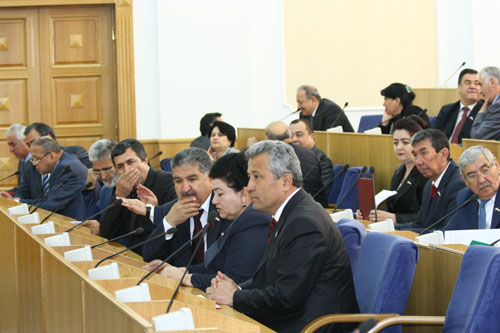
DUSHANBE, April 17, 2013, Asia-Plus — The currency regulation and control bill has been returned as requiring improvement because deputies of Tajikistan’s lower house (Majlisi Namoyandagon) of parliament have failed to decide on the notion of “currency.”
A regular sitting of the fourth session of the Majlisi Namoyandagon of the fourth convocation, presided over by its head, Shukurjon Zuhurov, took place on April 17.
Presenting the law, Abdujabbor Shirinov, head of the National Bank of Tajikistan (NBT), noted that it had been drafted for the purpose of achieving goals of the country’s monetary and credit policy in the context of Tajikistan’s joining the World trade Organization (WTO) as well as the actual situation in the country’s economy, finance, currency system and foreign trade.
According to him, the new law determines legal foundations and principles of currency regulation and control in Tajikistan.
Meanwhile, dispute over the notion of “currency” occurred. Some parliamentarians consider that this notion may refer only to foreign monetary units, while others say that the notion of “currency” refers to money in any form when in actual use or circulation.
After long debate, parliamentarians decided to return the bill as requiring improvement.
Today, the Majlisi Namoyandagon considered and endorsed bills requiring amendments to the laws on drugs, psychotropic substances and precursors, traditional handicrafts, etc.
Parliamentarians also considered and ratified the World Health Organization Framework Convention on Tobacco Control (WHO FCTC). The treaty came into force on February 27, 2005. It had been signed by 168 countries and is legally binding in 176 ratifying/accessioned countries. There are currently 20 non-parties to the treaty (11 which have not signed and 9 which have signed but not ratified).