
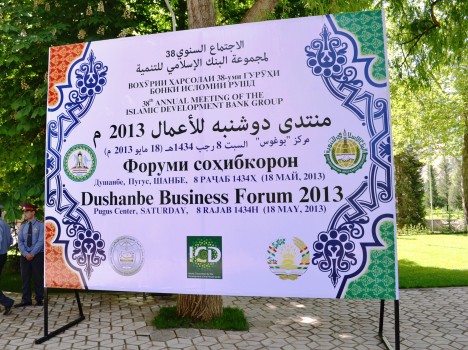
DUSHANBE, May 22, 2013, Asia-Plus – The 38th Annual Meeting of the Islamic Development Bank (IsDB) that concluded in Dushanbe on May 22 has resulted in signing of a number of documents.
The State Committee on Investments and State-owned Property Management of Tajikistan and the IsDB signed a grant agreement for the project for technical assistance for strengthening of activity of IsDB’s Country Office in Tajikistan.
The Government of Tajikistan and the IsDB signed a loan agreement for the Dangara Valley Irrigation Project.
The National Bank of Tajikistan (NBT) and the IsDB singed a loan and grant agreement for the Microfinance in Tajikistan Project.
The IsDB also signed memoranda of understanding on cooperation with the National Library of Tajikistan and Open Joint-Stock Company (OJSC) Orienbonk.
Besides, bilateral agreements between the IsDB and a number of the ISDB member nations were singed in Dushanbe today.
Meanwhile, the IsdB’s website reports that the Islamic Development Bank’s Board of Governors (BoG) on May 22 approved to more than triple the Bank’s authorized capital to 100 billion Islamic Dinars (about US$150 billion) from 30 billion Dinars, reflecting the Bank’s strong balance sheet and the growing economic development needs of its 56 member countries. The BoG also increased the Bank’s subscribed capital from 18 billion Islamic Dinars to 50 billion Islamic Dinars.
At its annual meeting in Dushanbe, the Bank reportedly also announced it will immediately tap the public market with a US $1 billion offering of sukuk, or Sharia-compliant bonds. The five-year offering is rated Triple A by each of the three major bond rating agencies (Standard & Poor’s, Moody’s and Fitch), and will be dually listed on the London Stock Exchange and Bursa Malaysia.
The benchmark US $1 billion offering comes amid strong demand and limited supply of the highest quality fixed-income securities, in part because a number of large governments have recently lost their Triple A status. There has also been growing demand for Islamic-compliant investments.
“The tenets of Islamic banking have stood the test of time,” said Dr. Ahmad Mohamed Ali, President of the IsDB Group. “Our emphasis on equity, risk-sharing and partnership enforces discipline on the financial system, allowing us to lift more of our people out of poverty.”
Saudi Arabia, with a 23.6% stake, has the largest ownership in the IsDB, followed by Libya with 9.5%, Iran with 8.3%, Nigeria with 7.7% and the United Arab Emirates with 7.5%. The next four biggest holders are Qatar (7.2%), Egypt (7.1%), Turkey (6.5%), and Kuwait (5.5%).
IDB provides project financing to diverse regions of the world, including a number of Less Developed Countries (LDS) that constitute part of its membership.
Although energy, transportation, and water and sanitation projects make up about 60% of the Bank’s portfolio, it has recently stepped up its commitments in agriculture, education, health and other social services.
