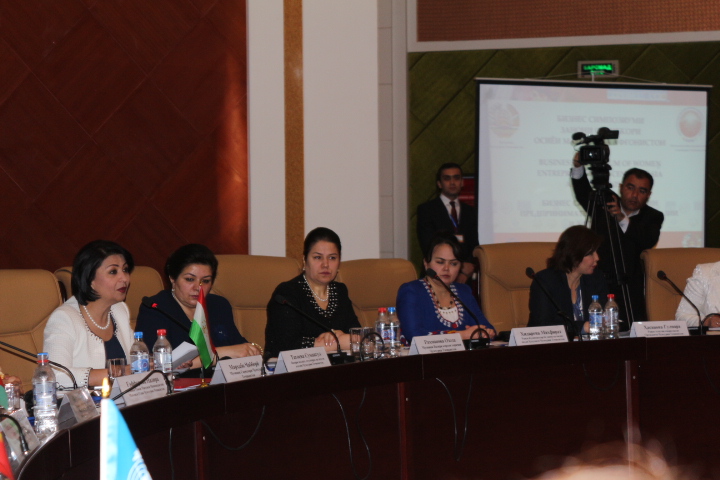
DUSHANBE, March 27, 2014, Asia-Plus — Issues related to problems and obstacles facing businesswomen in Central Asia and Afghanistan are a major topic of a two-day symposium that kicked off in Dushanbe today.
Organized by the European Bank for Reconstruction and Development (EBRD), the National Association of Business Women of Tajikistan (NABWT) and the Government of Tajikistan, the symposium has brought together more than 200 women entrepreneurs from Central Asia and Afghanistan. Parliamentary representatives from Central Asian countries as well as staff of development agencies, international and local financial institutions, and the media are also attending the event.
Speaking at the conference, Tajik Deputy Prime Minister, Ms. Marhabo Jabbori, noted on March 27 that the Government of Tajikistan provides thorough support to women and is interested in initiatives offered by the women of Tajikistan.
She stressed that all necessary conditions had been created in the country for an active promotion of entrepreneurship and investment and work on simplification of procedures for establishment of enterprises was under way.
Ms. Jabbori noted that the number of entrepreneurs rose 9 percent in a year to December 31, 2013, reaching 263,598, with 160,000 of them being women.
Gulbahor Mahkamova, Director-General of the NABWT, drew attention of the symposium participants to importance of a role of a business woman in society.
“Women now constitute 46 percent of the economically active population of Tajikistan,” said Ms. Mahkamova. “Despite this fact, very few women hold leading positions in the government. Only 10 percent of private companies in Tajikistan are headed by women.” According to her, their association has been promoting women entrepreneurs for over 20 years.
Mr. Richard Jones, Head of the EBRD Resident Office in Tajikistan, noted that corruption prevented women from developing their businesses. Despite their significant role in the country’s economy, Tajik businesswomen are mainly running small business, he said.
“Women have less access to markets, compared to men. There are cases of corruption. Such problems exist not only in Tajikistan, they also exist in many other countries and it is necessary to solve them jointly. It is necessary to support gender equality in society so that women and men would have equal opportunities,” Mr. Jones noted.
The event aiming to draw attention to the challenges faced by businesswomen and to discuss these issues has created a platform for high-level dialogue between the public and private sectors.
Topics reportedly include changes in the business environment, and identifying and overcoming key problems (such as limited access to information, lack of financial resources and training, unsupportive policy and regulatory frameworks).
The symposium has also provided a platform for discussions with high-level policy-makers, local and international experts. Participants have the opportunity to contribute their ideas on policy-making processes.
A varied program for the event gives entrepreneurs a chance to apply for presidential grants aimed at helping women in business. They are also working on building a database of women entrepreneurs for Tajikistan and learning about good business practices from international experts. Participants also have an opportunity to learn how to set up and manage their own businesses, understand mobile banking and work on proposals for an inclusive legal framework for women entrepreneurs.
In addition, the National Association of Business Women of Tajikistan (NABWT) will announce the winners of the competition for Best Business Plan among Young Entrepreneurs 2013, and will launch the Woman Entrepreneur of the Year – Farah 2014 competition.
Since the approval of the SGI in April 2013, the EBRD has been working to improve the gender impact of its operations. It seeks opportunities to improve women’s access to finance, employment and services, particularly in Central Asia, the southern and eastern Mediterranean, and Turkey.