

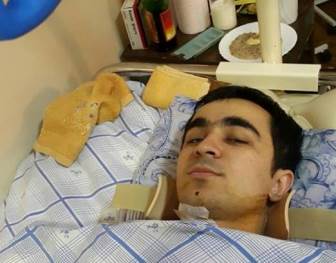
DUSHANBE, May 6, 2014, Asia-Plus – Surgery performed on Tajik soldier Shahbol Mirzoyev by Russian physicians in the Krasnogorsk military hospital was effective and he is on the way to recovery.
Shahbol’s father, Numon Mirzoyev, told Asia-Plus this by phone from Krasnogorsk (Russia). According to him, the surgery was performed on May 5 and the physicians have given optimistic prognosis.
“Initial outlay has already reached 370,000 Russian rubles while we still have to pay for the expensive surgery,” Mr. Numon Mirzoyev said.
We will recall that medic of military unit 2026 deployed in the Roudaki district, Usmon Ghayratov, reportedly severely beat soldier Shahbol Mirzoyev on March 6.
According to Shahbol Mirzoyev, medic Ghayratov together with other medics began to mock at him and beat him up for no reason. “Mostly Ghayratov was beating me up,” Shahbol noted.
As a result of the beating, Shahbol Mirzoyev suffered a broken neck, paralyzed left leg and injured hands.
The military prosecutor’s office instituted criminal proceedings against Usmon Ghayratov on March 14.
The criminal proceedings were instituted under the provisions of Article 373 of Tajikistan’s Penal Code – violation of military regulations; an investigation is under way.
In late March, Numon Mirzoyev applied to President Emomali Rahmon with solicitation to take investigation into the incident under his personal control.
According to some sources, Usmon Ghayratov is the son of employee of the Prosecutor-General’s Office, Mahmadsharif Ghayratov.
Iranian physicians were supposed to perform surgery on Shahbol. They were expected to arrive in Dushanbe in early April but they did not arrive because unit 2026 of the Main Border Guard Directorate Border of the State Committee for National Security (SCNS) did not transfer 56,000 somoni, needed for the first surgery, to the International Ibn Sina Clinic in Dushanbe.
Deputy chief of staff of the Border Guard Hospital, Narzullo Rasoulov, claimed that Shahbol Mirzoyev does not need surgery. “Shahbol Mirzoyev does not need the surgery. Twelve professors have examined him and according to them, points of injury of cervical vertebras have already knitted,” Rasoulov told Asia-Plus in an interview on April 17.
