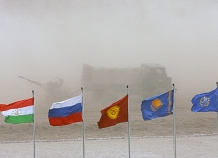
DUSHANBE, May 14, 2015, Asia-Plus – Redeployment of limited mobile groups from the CSTO member nations to Tajikistan within the framework of a sudden inspection of the readiness of servicemen of the Collective Operational Reaction Force (CORF) created within the framework of the Collective Security Treaty Organization (CSTO) to fulfill their missions is nearing completion, Faridoun Mahmadaliyev, a spokesman for the Ministry of Defense of Tajikistan (MoD), told Asia-Plus today morning.
According to him, Belarusian, Kazakh and Russian contingents were airlifted to the airports in Dushanbe and Qurghon Teppa yesterday night.
“Meanwhile contingents of Tajikistan and Kyrgyzstan are completing a forced march through a mountain area,” the MoD spokesman said, noting that Tajik and Kyrgyz servicemen have to march several hundred kilometers.
An Armenian contingent will be airlifted to Tajikistan today, Mahmadaliyev added.
“Yesterday alone, military transport aircraft of the CSTO member nations conducted 24 fights, including 19 flights conducted by Russian military transport planes, three flights conducted by Kazakh military transport planes and two flights conducted by Belarusian military transport planes,” the spokesman said.
The CORF contingents are reportedly exercising regrouping by air to the venue of the war game – to the territory of Tajikistan, where, in accordance with the plan, they will participate in the implementation of training tasks.
The CORF is a Russian initiative intended to transform and expand by three to four times the CSTO rapid reaction dimension into a permanently ready, combat-capable force designed for intervention in crisis situations on the territory of CSTO member states.
On February 4, 2009, an agreement to create the Collective Operational Reaction Force (CORF) was reached was by five (Armenia, Kazakhstan, Kyrgyzstan, Russia and Tajikistan) of the seven CSTO members. The force is intended to be used to repulse military aggression, conduct anti-terrorist operations, fight transnational crime and drug trafficking, and neutralize the effects of natural disasters. Belarus and Uzbekistan initially refrained from signing on to the agreement; Belarus because of a trade dispute with Russia, and Uzbekistan due to general concerns. Belarus signed the agreement in October 2009.
The CSTO now groups Armenia, Belarus, Kazakhstan, Kyrgyzstan, Tajikistan, and Russia. Uzbekistan suspended its membership in the CSTO in June 2012, saying the organization ignores Uzbekistan and does not consider its views. The CSTO is currently an observer organization at the United Nations General Assembly.