

Incomes from Afghan drug business may pass on to ISIL group, says Afghan expert
DUSHANBE, June 5, 2015, Asia-Plus – Desperate struggle may begin soon between the Taliban and the Islamic State of Iraq and the Levant (ISIL) militants for control over the Afghan drug market, Omar Nessar, Director of the Center for Contemporary Afghan Studies (CISA), told Asia-Plus in an interview.
“According to Afghan experts estimates, ISIL militants may earn a fat profit from drug trafficking this year,” said Nessar, “The Taliban militants have begun losing their positions in the Afghan heroin business that will lead to weakening of their financial base.”
It is quite possible that ISIL supporters will get 30-35 percent of incomes from Afghan drug trafficking this year, Nessar noted, adding that considerable part of additional incomes will be received by ISIL militants within the next few months.
“In this connection, our expert suppose that the provinces of Hilmand and Nangarhar will be the main sites of struggle between the Taliban and ISIL militants for influence in the country’s drug market,” Nessar said.
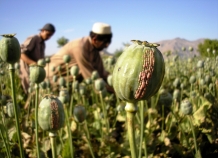
Meanwhile, the United Nations Office on Drugs and Crime (UNODC)’s 2014 Afghan Opium Survey says the Afghan opium cultivation once again hit a record high last year.
The survey notes that the total area under opium poppy cultivation in Afghanistan was estimated at 224,000 hectares in 2014, a 7% increase from the previous year.
The vast majority (89%) of opium cultivation reportedly took place in nine provinces in Afghanistan’s Southern and Western regions, which include the country’s most insecure provinces.
Hilmand remained Afghanistan’s major opium-cultivating province, followed by Kandahar, Farah, and Nangarhar. Opium cultivation increased in most of the main poppy-cultivating provinces, but stabilized in Hilmand itself (+3%).
Total eradication of opium poppy reportedly decreased by 63% in 2014, to 2,692 hectares. Average opium yield amounted to 28.7 kilograms per hectare in 2014, which was 9% more than in 2013 (26.3 kilograms per hectare).
The Afghanistan Opium Survey is implemented annually by the Ministry of Counter Narcotics (MCN) of Afghanistan in collaboration with the United Nations Office on Drugs and Crime (UNODC).
