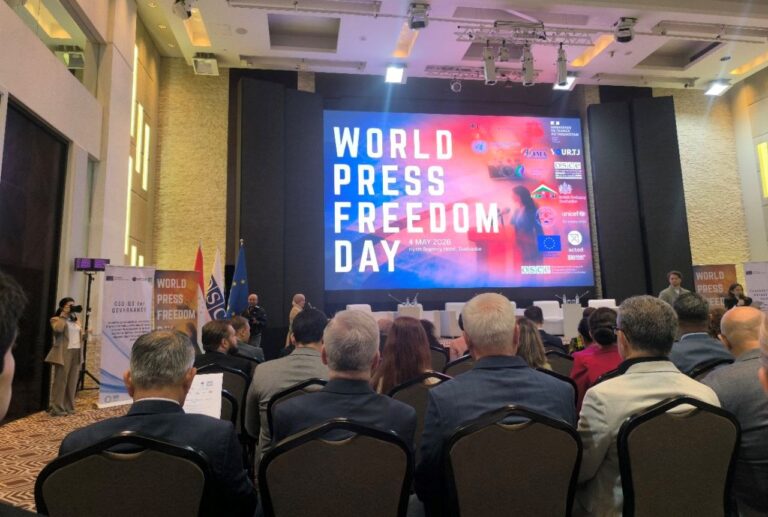
DUSHANBE, March 12, Asia-Plus — Over 250 medical specialists and government representatives from the region gathered at the international three-day conference “HIV Epidemic in Central Asia and Neighboring Countries: Surveillance Approaches and Challenges for Control and Prevention” that opened n Bishkek, Kyrgyzstan yesterday.
The conference is organized by the United States Agency for International Development (USAID), the U.S. Centers for Disease Control and Prevention (CDC), the Central Asia AIDS Control Project (CAAP), and the Global Fund to Fight AIDS, Tuberculosis and Malaria (GFATM).
Mr. Andrey Sidorin, Communications Coordinator and Strategist, Central Asia AIDS Control Project, said that CDC experts and representatives from the ministries of health (MoHs) of Central Asian countries are sharing their experiences on the implementation of the WHO-recommended second-generation sentinel surveillance. Central Asian participants are also discussing the results of current HIV epidemiological situational assessments, the response measures, and the surveillance results with delegates from neighboring countries of India, Afghanistan, Russia and China.
Around the world WHO-recommended second generation surveillance has emerged as an effective tool for exploring dynamics of HIV infection and monitoring and evaluating program response. To address growing information needs on the HIV situation in their countries, concepts of second-generation surveillance have been incorporated into the national HIV surveillance systems in Kazakhstan, Kyrgyz Republic, Uzbekistan, and Tajikistan. USAID, CAAP, Global Fund, and CDC have facilitated this process with financial and technical support. The implementation of such system, including the more effective use of the data generated by the system, will ensure that Ministries of Health of Central Asia and neighboring countries are in the best possible position to respond to the challenges of the HIV epidemic.
The U.S. Government, through USAID and CDC and its major role in the Global Fund, stands ready to help the Governments of Central Asian Republics build on existing programs and develop a comprehensive HIV/AIDS prevention program.
The results of sentinel surveillance conducted with funding from USAID in 2006 demonstrated that there are territories where HIV prevalence exceeds 5% among vulnerable groups in each of the Central Asian countries, which suggests a concentrated HIV epidemic in the region. Building on the work of USAID, the MoHs, and CDC, CAAP is expanding sentinel surveillance to thirteen new pilot sites within four Central Asian countries, including plans to develop and implement electronic surveillance of HIV and AIDS cases in 2008.
The United States Agency for International Development (USAID) is the key provider of the U.S. government foreign assistance across the world. USAID programs in Central Asia focus on improving private sector competitiveness, supporting democratic institutions, and strengthening health sector. This assistance includes funding for three HIV/AIDS programs in Central Asia to assist the local governments with HIV/AIDS surveillance, prevention, and treatment.
CDC is recognized as the primary U.S. governmental agency for protecting the health and safety of people, both within the United States and internationally. In partnership with host countries and other organizations, CDC promotes health and quality of life by preventing and controlling diseases, injuries, and disabilities by increasing capacity in epidemiologic surveillance, laboratory science, and public health management.
The CAAP Project, funded by the World Bank and the UK Department for International Development (DFID) and under the auspices of the Eurasian Economic Community (EAEC), is aimed at the prevention of the generalization of HIV epidemics in Central Asia by strengthening capacity and cooperation between the public, nongovernmental (NGOs) and private sectors, both nationally and regionally, through the establishment of the Regional AIDS Fund, a sustainable mechanism for financing HIV counteraction activities. The main project components include improving the Regional Coordination and Institutional Strengthening; the Central Asia Regional AIDS Fund; and Monitoring and Evaluation. Information on the CAAP