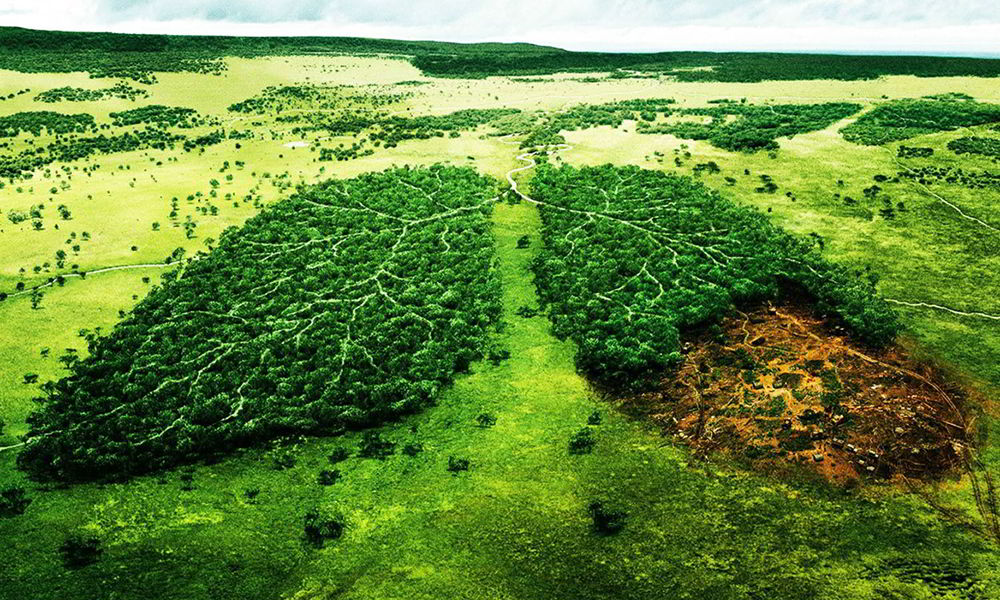
Humans have already used up their allowance for water, soil, clean air and other resources on Earth for the whole of 2017.
This year, Earth Overshoot Day is on August 2, according to environmental groups WWF and the Global Footprint Network.
The date, earlier this year than in 2016, means humanity will survive on “credit” until 31 December.
“By August 2 2017, we will have used more from Nature than our planet can renew in the whole year,” the groups said in a statement.
“This means that in seven months, we emitted more carbon than the oceans and forests can absorb in a year, we caught more fish, felled more trees, harvested more, and consumed more water than the Earth was able to produce in the same period.”
According to campaigners, the equivalent of 1.7 planets would be needed to produce enough natural resources to match our consumption rates and a growing population.
The Earth Overshoot Day measure has been calculated since 1986 and the day has never fallen so early as in 2017. It looks at the balance between global footprint – what humans take from the earth – and biocapacity, which allows us to produce resources and absorb our waste.
The Independent notes that in the 1980s, the overshoot day fell in November, shifting back to October by 1993 and to September just after the millennium. By 2016 it had reached August 8.
Founded in 2003, Global Footprint Network is an independent think tank originally based in the United States, Belgium and Switzerland. It was established as a charitable not-for-profit organization in each of those three countries.
Global Footprint Network develops and promotes tools for advancing sustainability, including the ecological footprint and biocapacity, which measure the amount of resources we use and how much we have. These tools aim at bringing ecological limits to the center of decision-making.
Every year, Global Footprint Network produces a new edition of its National Footprint Accounts, which calculate Ecological Footprint and biocapacity of more than 200 countries and territories from 1961 to the present. Based on up to 15,000 data points per country per year, these data have been used to influence policy in more than a dozen countries, including Ecuador, France, Germany, Japan, Korea, the Philippines, Russia, Switzerland, and the United Arab Emirates.
The 2017 Edition of the National Footprint Accounts cover 1961-2013 (latest UN data available), and incorporate data from the Food and Agriculture Organization, the UN Comtrade database, the International Energy Agency, and over 20 other sources.