A ten-day military exercise of the Collective Security Treaty Organization (CSTO) Collective Rapid Reaction Force in Tajikistan has seen repeated deployment of the Iskander-M missile system to Tajikistan.
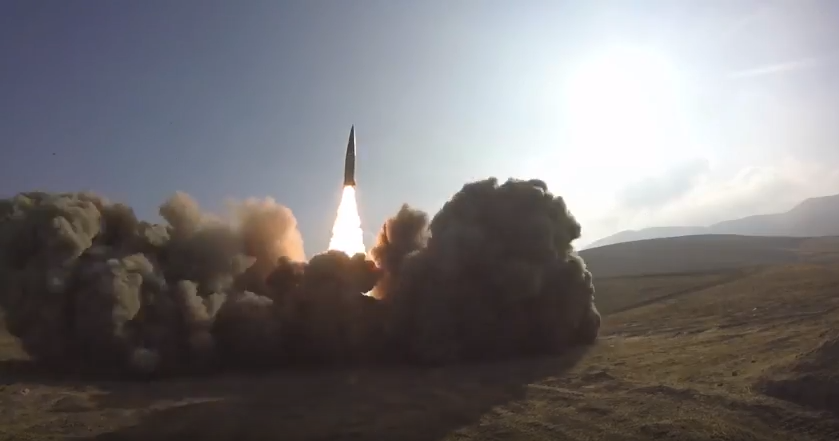
Russia’s TASS news agency, citing Yaroslav Roschupkin, a spokesman for Russia’s Central Military District, reported on November 17 that the Iskander-M complex fired a missile from the Lohour military range, just 30 kilometers of Dushanbe, over a range of 130 kilometers at a simulated terrorist training camp. The target was at a location in the Harbmaydon training ground in the Khatlon province, some fifteen kilometers to Tajikistan’s border with Afghanistan.
Roschupkin reportedly said the Iskander-M had struck its target to within a 10-meter degree of accuracy and that the test had confirmed the system’s “invisibility to detection equipment.”
Recall, the system was initially brought to Tajikistan in May this year for use at the CIS anti-terror exercise. That marked the first ever use of the Iskander-M system outside Russia.
The Iskander-M missile system was officially adopted by the Russian Army in 2006. As of 2017 Russian Army reportedly operates 112 of these missile systems. At least one launcher was deployed in Syria. In 2016 Iskander-E ballistic missiles were delivered to Armenia.
The Iskander road mobile missile system is equipped with two short-range ballistic missiles, which substantially increases firepower of missile units. Each missile can be targeted independently. These missiles are capable of hitting moving targets, as target coordination can be adjusted while the missile is in-flight. The Iskander has several different conventional warheads, including cluster, fuel-air explosive, bunker-busting and electro-magnetic pulse. It can also carry nuclear warheads despite the fact that this will violate the INF treaty. Maximum range of fire is 280 km for the Iskander-E downgraded export version and 400 km for the Iskander-M Russian Army version. Minimum range is 50 km.
The Iskander was designed to overcome air defense systems. Missile ravels at supersonic speed. In the terminal phase of the flight it excessively maneuvers and releases decoys. In some cases this ballistic missile can be used as an alternative to precision bombing.
Missiles can be launched 16 minutes from traveling or 4 minutes from highest readiness. The second missile can be launched in less than a minute once the first missile is launched.