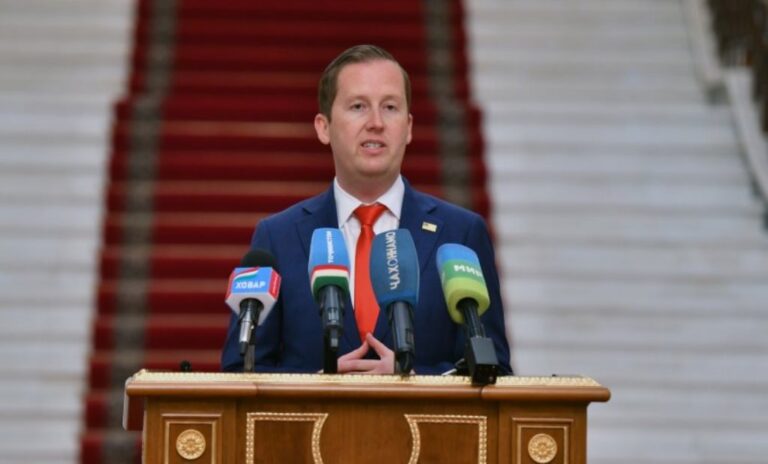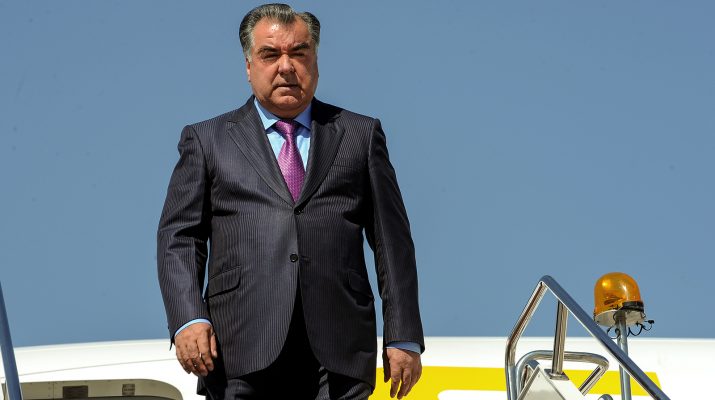
Tajik President Emomali Rahmon today morning departed for the Kazakh capital, Astana, on an official visit.
According to the Tajik president’s official website, Tajikistan and Kazakhstan intend to sign a new package of cooperation agreements.
Current legal foundation of bilateral cooperation between Tajikistan and Kazakhstan includes 75 documents.
According to Kazakhstan’s Ambassador to Tajikistan Nurlan Seitimov, the two sides will discuss the state and prospects of further expansion of bilateral cooperation between Kazakhstan and Tajikistan as well as a number of regional and international issues being of mutual interest.
A special attention will be given to trade and economic cooperation between the two countries, Kazakh diplomat said.
Ambassador Seitimov further added that the presidents would sign a joint statement and three government-to-government agreements concerning readmission of persons, rules and regulations for stay of citizens the countries and cooperation in the field of migration.
The sides also expected to sign a program of cooperation between the foreign ministries of the two countries.
On March 15, Tajik leader will participate in the first consultative meeting of heads of state of Central Asia.
It will be the first summit of Central Asian leaders in nearly a decade though it is already clear that Turkmen President Gurbanguly Berdimuhamedow will not attend. Ashgabat is sending a delegation led by the speaker of the parliament.
Meanwhile, some regional experts consider that the upcoming working meeting of leaders of the Central Asian nations will be a serious breakthrough in the regional cooperation.
The meeting is expected to play a key role in expansion of cooperation between the Central Asian nations and give start to implementation of programs and projects meeting the long-term interests of all countries of the region.
Before that the leaders of the five Central Asian nations have held informal meetings and have met within the frameworks of the CIS, the Shanghai Cooperation Organization (SCO), etc.
Thus, an informal summit of Central Asian leaders took place in the Kazakh capital on September 2, 2006. The informal meeting brought together the presidents of Kazakhstan, Kyrgyzstan, Tajikistan, and Uzbekistan for talks to discuss economic and other issues. One of the most important topics on the meeting’s agenda was the creation of an international consortium to manage the region's water resources.
Central Asian experts consider that 2018 will be a turning-point for the Central Asian nations in expanding regional cooperation.
Erlan Karin, Director of Kazakhstan Institute for Strategic Studies, believes that relations between the Central Asian countries will develop this year in all spheres.
Some local experts consider that Kazakhstan is seeking to reprise its role as a locomotive for regional integration by calling for a landmark summit of Central Asian leaders.
Kazakh President Nursultan Nazarbayev reportedly reiterated calls for the integration of Central Asian countries as a way to jointly ensure the security and prosperity of the region on November 13 last year, while answering questions at the 3rd session of the Astana Club, a Kazakhstani government-backed international forum aimed at discussing Eurasian issues.
He pointed to recent developments in Kazakhstan's relationship with Uzbekistan as an example of moving towards better regional integration.
Kazakhstan proposed hosting a Central Asian leaders' summit in Astana in October last year.
Kazak Foreign Minister Kairat Abdrakhmanov voiced the proposal on October 11, 2017 during a speech in Samarqand, Uzbekistan, at the UN-sponsored conference devoted to security and sustainable development in Central Asia.
Kazakhstan advocates forming a model regional zone for peace, security and cooperation in Central Asia and Afghanistan, Abdrakhmanov said.
Uzbek President Shavkat Mirziyoyev, speaking at the October 11 conference in Samarqand, supported Nazarbayev's initiative, eyeing a new course for development focused on closer co-operation with neighbors.
Central Asian experts consider that geographic factors could turn Uzbekistan into a vehicle for regional cooperation because it borders all four other Central Asian states — Kazakhstan, Kyrgyzstan, Tajikistan and Turkmenistan — as well as Afghanistan.