
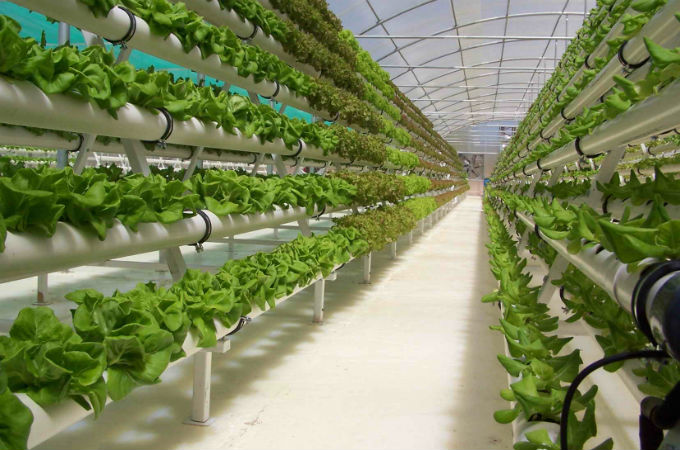
South Korea’s Myung Sung Placon Ltd has begun building hydroponic greenhouses in the northern Sughd province. The hydroponic system has an ancient history and was reportedly used for building of the Hanging Gardens of Babylon.
The use of the hydroponic system will help increase productivity, according to the Sughd regional administration.
The building of the hydroponic greenhouses began in the Somgor area of the Bobojon-Ghafourov district on January 7.
An official source at the Sughd regional administration says local “Bars” Company is a contractor and specialists from South Korea are implementing the project.
Sughd authorities have invited Myung Sung Placon Ltd to build greenhouses in the province, taking into account the company’s experience of work in the neighboring Uzbekistan, the source added.
Hydroponic growing is growing a plant without using soil – usually in an inert substance like rockwool or perlite, which hold the roots for easy water and nutrient absorption. Hydroponics systems back several hundred years, and there is evidence that ancient civilizations grew plants in water. Nutrients are vital to hydroponic success: there are sixteen essential elements that a plant needs to grow, and the right balance of these nutrients must be maintained for each specific variety of plants. Equally as important as nutrition are the factors of light, temperature (heating and cooling), and carbon dioxide. Insects play a key role in pollination and pest management.
The Hanging Gardens of Babylon were one of the Seven Wonders of the Ancient World and were described as a remarkable feat of engineering with an ascending series of tiered gardens containing a wide variety of trees, shrubs, and vines, resembling a large green mountain constructed of mud bricks, and said to have been built in the ancient city of Babylon, near present-day Hillah, Babil province, in Iraq. Its name refers to trees being planted on a raised structure such as a terrace.
According to one legend, the Hanging Gardens were built alongside a grand palace known as The Marvel of Mankind, by the Neo-Babylonian King Nebuchadnezzar II (who ruled between 605 and 562 BC), for his Median wife Queen Amytis, because she missed the green hills and valleys of her homeland. The construction of the Hanging Gardens has also been attributed to the legendary queen Semiramis, who supposedly ruled Babylon in the 9th century BC, and they have been called the Hanging Gardens of Semiramis as an alternate name.
