

Children with more education tend not only to be more concerned about the environment, but also more likely to engage in actions that promote and support measures that protect the environment. By increasing awareness and concern, education can encourage schoolchildren to reduce the impact on the environment through more efficient use of natural resources.
The Food and Agriculture Organization of the United Nations (FAO) and Cambridge Worldwide Academy in Tajikistan held a joint event on January 29.
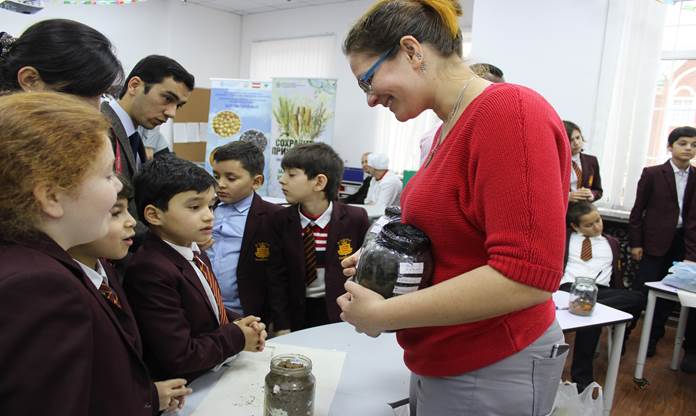
According to FAO office in Tajikistan, the event focused on the importance of sustainable agriculture and saving soil and natural resources. The lessons, organized as port of science classes for schoolchildren between 9 and 13 years old, reportedly centered on how to maintain soil productivity and avoiding soil degradation and pollution.
Sustainable agriculture promotes producing long-term crops while having minimal effects on the environment. There are several other goals associated with sustainable agriculture, including conserving the soil and water, reducing the use of fertilizers and pesticides and promoting biodiversity in crops grown and ecosystems.
Schoolchildren made their presentation on the value and importance of soil and benefits of healthy soil to human being and plants. Through master classes that were delivered by FAO specialists, they practiced how to prepare compost from food residues properly and how to plant leguminous seeds. They learnt about healthy food and the significant role of pulses in the human’s diet and for soil health.
“The main benefit of this kind of event is that the children learn how to grow healthy food and how to use it for better nutrition. It is important for them to learn how, by changing diets and by sustainable consumption and utilization of their foods, they can influence the production patterns and improve soil conditions.,” said Oleg Guchgeldiyev, FAO Representative in Tajikistan. “Learning this from a younger age will help to preserve the planet’s resources and achieve zero-hunger in the future.”
These activities have many opportunities that are accessible to pupils of all ages. While well-made compost is an incredibly useful material and wonderful soil improver, the pulses are highly versatile ingredients to cook with. They contain about twice as much protein as most grains, making these legumes an important food staple around the world.
“We are delighted that we can form such a cooperation. And we are eternally grateful to FAO for time and resources for our library,” emphasized . Steve Byrd, Deputy Principal.
