The significant slowdown in economic growth of Tajikistan is linked to intensification of negative effect of reduction in remittances.
The International Monetary Fund (IMF) says in its latest update to its Regional Economic Outlook assessment that slowdown in economic growth of Tajikistan is expected to be the most significant in the Caucasus and Central Asia (CCA) region since continuous consolidation of budget intensifies the negative effect of reduction in remittances.
In 2018, real growth of Tajikistan’s gross domestic product (GDP) was 7.0 percent, which was the highest rate among the countries of the region.
The Aril 2019 IMF’s update to its Regional Economic Outlook says Tajikistan’s GDP growth will slow to 5.0 percent in 2019 and 4.5 percent in 2020.
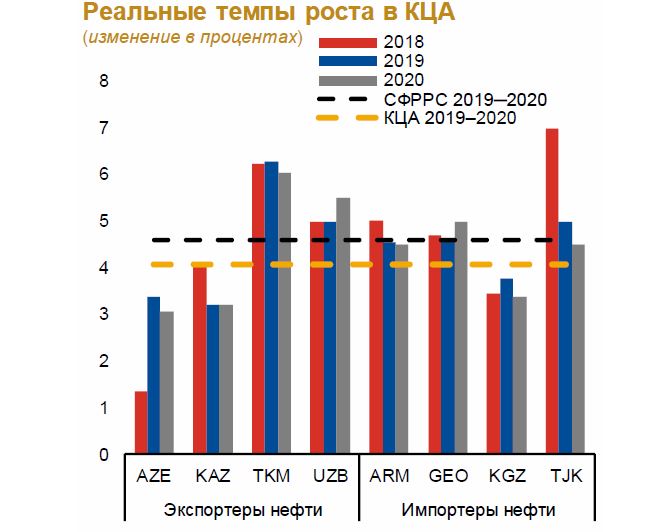
The report notes that growth in the Caucasus and Central Asia region remains stable but is still too low to lift living standards over time.
With growth projected at 4.1 percent in 2019 and 2020, the CCA region’s outlook is reportedly little changed from the 4.2 percent growth seen last year.
Growth in the CCA region reportedly stabilized after recovering from large external shocks during 2014–16, benefiting from efforts to strengthen macroeconomic policy frameworks. Nevertheless, growth remains too low to raise the region’s living standards. Legacy challenges from banking system risks and incomplete institutional and structural reforms hinder investment and productivity gains, restraining activity and threatening the region’s medium-term growth potential. Addressing vulnerabilities is more urgent amid global growth and policy uncertainty. Decisive policies to repair financial systems, complete transitions to modern monetary policy frameworks, remove structural rigidities, and improve governance are key to boosting economic resilience, enhancing competitiveness, and ensuring higher medium-term inclusive growth.