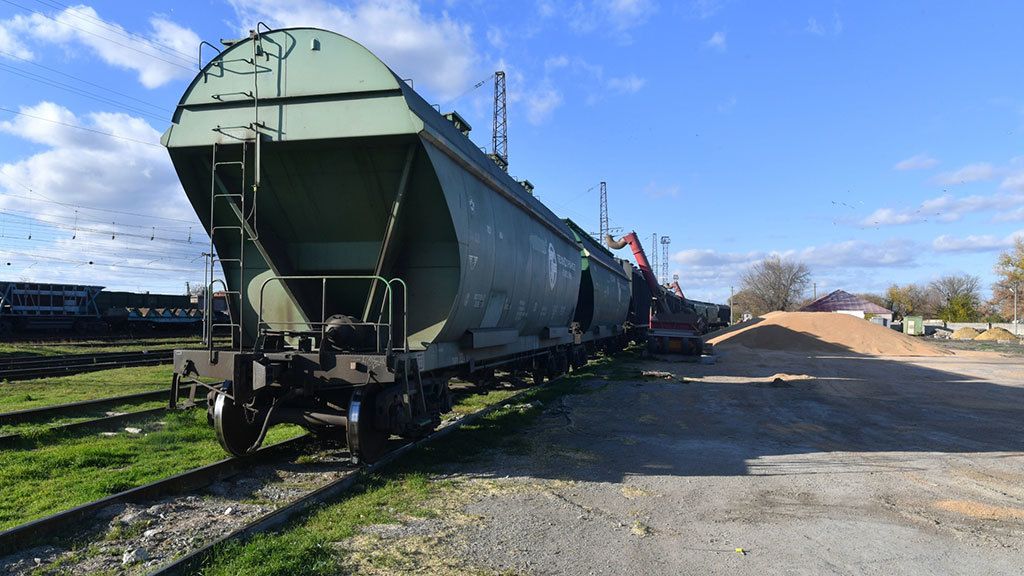
Russian Railways has asked Kazakhstan to reduce the transit tariff for shipment of agricultural goods, including grains, through its territory.
This issue was discussed at a closed meeting of Russian Railways managers with MPs from the ruling United Russia Party that took place on November 8, an official source at the Russian Railways told Vedomosti in an interview on November 14.
Russian railways press center has reportedly confirmed that they “are carrying out dialogue” on this issue with the Kazakhstan Temir Joly (KTJ – Kazakh Railways) jointly with senior representatives of Russia’s Omsk, Orenburg and Novosibirsk oblasts.
Meanwhile, Alexander Korbut, Vice-president of the Russian Grain Union, told Vedomosti that Kazakhstan had actually blocked Russia’s grain shipments to Central Asia’s nations and China.
According to him, the reason is transit tariffs set by the KTJ, because of which grain shipments have become “economically impractical.”
“Actually, large-scale shipments to Central Asia’s nations and transit to China through Kazakh territory are blocked for Russia,” said Korbut. “This gives competitive advantages to Kazakhstan and allows it to re-export Russian grain.”
According to the Russian Railways, the cost of shipment of one ton of grain through territory of Kazakhstan at a distance of about 2,000 kilometers is about 2,500 Russian rubles against 1,300 Russian rubles for shipment of one ton of grain at the same distance through Russian territory.
“in reality, the gap is even bigger,” says the official source within the Russian Railways. “Transit through Kazakhstan costs carriers 3,150-3,300 rubles per ton, while a similar Russian route costs 600-630 rubles. This is due to the fact that the transit tariff is tied to the Swiss Franc exchange rate.”
As a result of that, “dropout export volumes” appear: Russian grain does not reach Uzbekistan, Kirgizia, Turkmenistan and China, the source within the Russian Railways noted, adding that problems also arose with supplies to the Taliban government.
He further noted that the problem had already been brought to the level of the State Duma (Russia’s lower chamber of parliament).
“Russian Railways managers have already met with MPs from the United Party and asked them to achieve a reduction in tariffs by Kazakhstan,” the source added.
As far as Tajikistan is concerned, Kazakhstan’s decision to raise transit tariffs for Russia’s grain shipments through its territory will not affect Tajikistan, because Kazakhstan provides the bulk its wheat imports. Kazakhstan accounts for 98 percent of Tajikistan’s wheat imports, while import of grains from Russia is carried out in insignificant volumes.
According to official statistics, Tajikistan has imported about 640,000 of wheat over the first nine months of this year, which is 7.8 percent fewer than in the same period last year.
Over the same nine-month period, wheat accounted for 5.8 percent of Tajikistan’s imports.