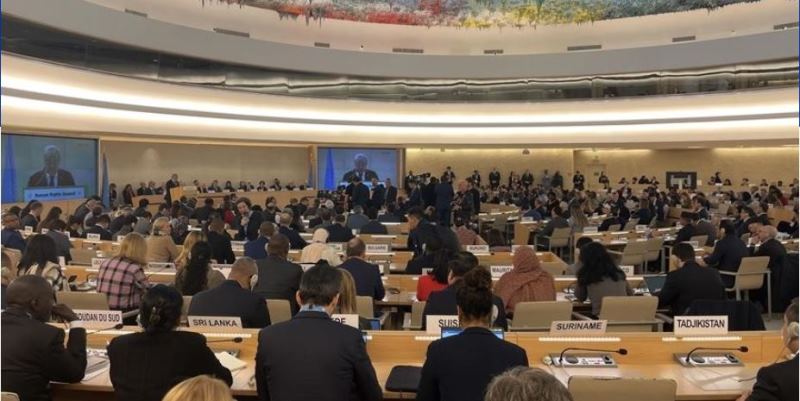
The Human Rights Council (HRC) Tuesday afternoon held an urgent debate on the alarming rise in premeditated and public acts of religious hatred as manifested by recurrent desecration of the Holy Quran in some European and other countries.
According to HRC, action on a draft resolution on “Countering religious hatred constituting incitement to discrimination, hostility or violence” was postponed to Wednesday, 12 July at 10 a.m. because of time constraints.
Meanwhile Turkiye’s Anadolu Agency (AA) reported on july 12 that the draft resolution was presented by Pakistan on behalf of the 57-member Organization of Islamic Cooperation (OIC).
The resolution, which calls for condemnation of attacks targeting the Quran and described them as "acts of religious hatred," was put to vote by the 47-member council.
The resolution was adopted with 28 countries voting in favor, 12 countries voting against it, and 7 countries abstaining at the 53rd regular session of the UN Human Rights Council.
Countries that voted in favor of the resolution included Algeria, Argentina, Bangladesh, Bolivia, Cameroon, China, Ivory Coast, Cuba, Eritrea, Gabon, Gambia, India, Kazakhstan, Kyrgyzstan, Malawi, Malaysia, Maldives, Morocco, Pakistan, Qatar, Senegal, Somalia, South Africa, Sudan, Ukraine, United Arab Emirates, Uzbekistan, and Vietnam.
Belgium, Costa Rica, the Czech Republic, Finland, France, Germany, Lithuania, Luxembourg, Montenegro, Romania, the UK, and the US voted against the resolution.
Turkiye does not have the right to vote, as it has observer status at the UN Human Rights Council.
Also, the UK, US and some European Union member countries reportedly rejected condemning the burning of the Quran during an urgent debate on July 11 at the UN Human Rights Council over the rising number of attacks against the Muslim holy book.
ARTICLE 19 on July 11 delivered a joint statement during the urgent debate on public acts of religious hatred as manifested by recurrent desecration of the Holy Quran at the 53rd Session of the UN Human Rights Council.
“We are dismayed over the rise of hate against persons on the basis of their religion or belief worldwide. While we underline that the burning of holy books is considered disrespectful and offensive by many, such acts should only be challenged through open space for dialogue, debate, and dissent, and not through prohibitions on defamation of religions or similar restrictions,” says the statement.
ARTICLE 19 notes that this Council in 2011 adopted Resolution 16/18, a landmark achievement that set out a consensual action plan for addressing religious intolerance. This resolution replaced divisive calls to combat defamation of religions in favor of a positive agenda driven by the understanding that the rights to freedom of expression, freedom of religion or belief, and equality are mutually dependent and reinforcing. “Resolution 16/18 remains a testament to the work of this Council in striking consensus and finding solutions to problems that affect us all. We fundamentally believe that Resolution 16/18 already provides us with a holistic framework to address the root causes of religious intolerance,” the statement notes.
ARTICLE 19 does not believe this current draft resolution is the solution to the problem, but rather that it will undermine existing efforts to combat religious intolerance.
“We stress that the ‘desecration’ of religious books and symbols in and of itself is not an act of incitement. It is clear that international human rights law protects individuals and not religions, and that prohibitions on the defamation of religions are contrary to the rights to freedom of expression and religion or belief,” the statement says.
ARTICLE 19 urges HRC members to reject the draft resolution unless significant changes are made to bring it in line with international human rights standards, and instead reaffirm their commitment to Resolution 16/18 and other existing frameworks such as the Rabat Plan of Action.