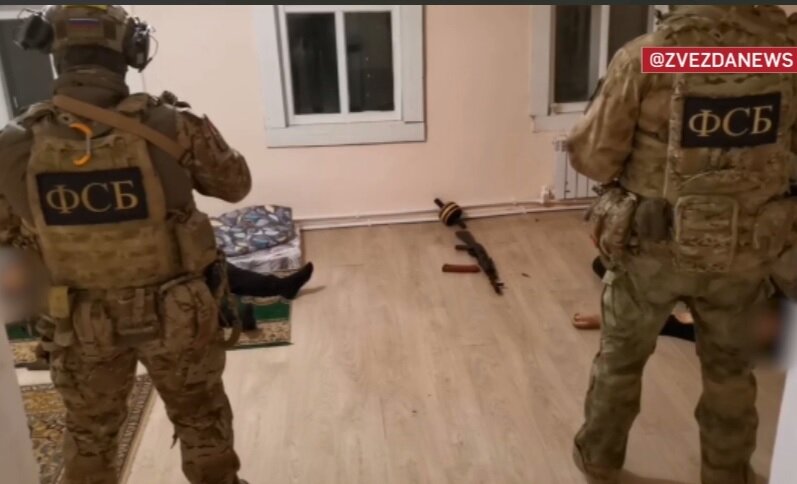
Russia's Federal Security Service (FSB) said on March 7 that it has prevented an attack on a synagogue in Moscow that was plotted by a cell of the Islamic State-Khorasan (IS-K) terrorist organization
FSB’s official website says FSB has stopped the activities of IS-K cell in Kaluga oblasts. Members of this cell were reportedly planning “to commit a terrorist act against one of the Jewish religious institutions in Moscow.”
Criminals reportedly “came to the attention of security authorities persons who collected relevant information.”
“During further operational-search activities, it was established that the militants are preparing to attack the synagogue parishioners with the use of firearms,” says the FSB’s website.
The terrorists reportedly resisted arrest and “were neutralized by return fire,” the FSB said.
The investigative department of the FSB’s Office in Kaluga Oblast has instituted criminal proceedings under the provisions of two articles of Russia’s Penal Code (Article 30 (2) and Article 205 (2)); an investigation is under way.
Meanwhile, Kazakhstan’s Committee for National Security (KNB) reported on March 9 that media outlets have published a report that “Russia’s power-wielding structures liquidated to two Kazakh citizens who were plotting a terrorist attack in the Russian Federation.”
The Kazakhstan citizenship and departure of these persons to Russia are reportedly confirmed and the KNB is conducting a pre-trial investigation into this fact.
IS-K is active in South Asia and Central Asia. IS-K has been active in Afghanistan and its area of operations includes Pakistan, Tajikistan and India where they claimed attacks, as well as Sri Lanka, the Maldives, Bangladesh and China where individuals have pledged allegiance to it. The IS-K and Taliban consider each other enemies.
The group was created in January 2015 by disaffected Taliban in eastern Afghanistan, although its membership includes individuals from various countries notably Pakistan, Bangladesh, India and Myanmar. Its initial leaders, Hafiz Saeed Khan and Abdul Rauf Aliza, were killed by US forces in July 2016 and February 2015, respectively. Subsequent leaders have also been killed; its leader Abdullah Orokzai was captured in April 2020 by Afghanistan's intelligence service.