A court in Dushanbe’s Firdavsi district has passed sentence on the woman, whose daughter failed for months to attend school.
The court has reportedly imposed a fine of more than 6,000 somonis on the woman.
An article by Ms. Gulrukhsor Aslamzoda,the deputy chairperson of the court in Dushanbe’s Firdavsi district, published in Qonun va Jomea (Law and Society) weekly on April 4, in particular, says that the 57-year-old Firouza Sainuriddinova intentionally prevented her daughter from attending school.
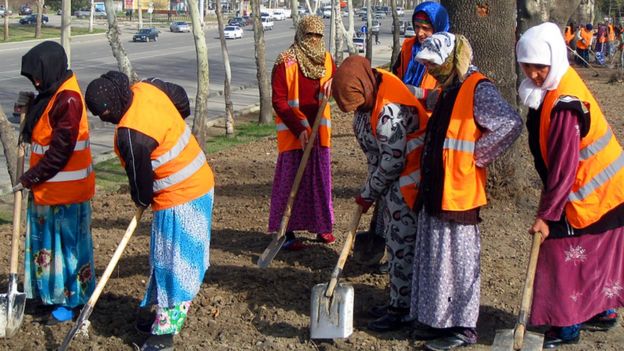
It is not reported whether the woman, who works as yard keeper, was able to pay the fine in the amount of 6,800 somonis.
The opinion of the woman about why her daughter has not attended school is also not given.
Meanwhile, some parents, who were fined for children’s truancy in the previous years, said that they were not in position of buying their children clothes and shoes
Tajikistan’s Constitution obliges parents to enable their children to attend school and now all children between the ages of seven and 17 must do so.
Recall, under amendments made to the country’s law on education, attending grades 10-11 (upper secondary education) in school has become compulsory in Tajikistan. Before that education from grades 1-9 was compulsory. Now, if students do not want to continue studying in grades 10-11, they must continue studying at vocational technical schools.
Tajikistan’s education system is structured so that the primary school cycle lasts 4 years, lower secondary lasts 5 years, and upper secondary lasts 2 years.
The country’s education system, which follows the model adopted when the country was part of the former Soviet Union, comprises: (i) preschool education; (ii) 11 years of general education, including primary (grades 1–4), lower secondary (grades 5–9), and upper secondary (grades 10–11); (iii) primary vocational education and training (PVET); (iv) secondary vocational education and training; and (v) higher education. Everyone has the right to education.
The Ministry of Education and Science (MoES) manages all levels of the education system except for PVET, which is under the Ministry of Labor, Migration and Employment (MoLME).
Compulsory education refers to a period of education that is required of all people and is imposed by the government. This education may take place at a registered school or at other places.