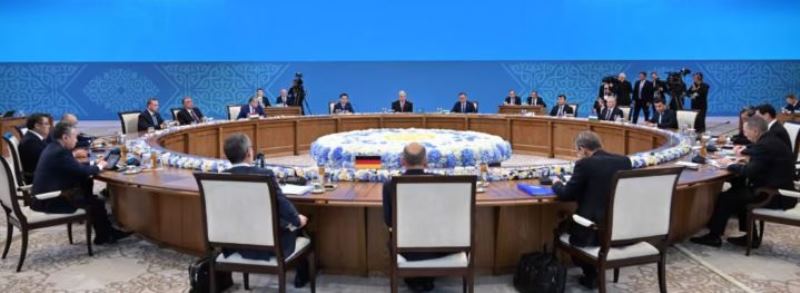
The Heads of the Central Asian nations and the Federal Chancellor of Germany adopted a Joint Declaration.
The Leaders, in particular, reaffirmed their commitment to further strengthen the German-Central Asian partnership based on shared values, mutual respect and interests and to continue the high-level dialogue.
They also reaffirmed their commitment to work together for peace, security, democracy, the rule of law and sustainable development in full respect of international law.
The Leaders expressed their continuing commitment to uphold the United Nations Charter, in particular the principles of respect for the independence, state sovereignty and territorial integrity of all countries, the non-use of force or threat of its use, and the peaceful settlement of international disputes.
They underlined that a peaceful resolution of conflicts, crisis management efforts, diplomacy and constructive dialogue are essential.
As with regard to any conflict, the Leaders expressed support for a just and durable peace based on respect for international law, the principles of the United Nations Charter, territorial integrity, and sovereignty as well as human rights and fundamental freedoms.
They emphasized the significance of close exchanges on sanctions regimes, including dialogue with the EU, and of further efforts to prevent the evasion of sanctions.
The Leaders expressed their interest in further exploring possibilities for active exchange of information, experiences and best practices in the area of deradicalization and prevention of extremism among youth. The Leaders stated their readiness to consider exchange on recruitment, training, and qualification enhancement of law enforcement personnel, including best-practice and training possibilities of the German Joint Counter-Terrorism Center.
Regarding the situation in Afghanistan, the Leaders agreed on the necessity of provision of humanitarian assistance to the Afghan people and acknowledged the efforts of the international community, including the UN, the EU as well as Germany and the Central Asian states, in this field. They reaffirmed their strong commitment to the development of Afghanistan as a secure, peaceful, stable and prosperous country that respects human rights and fundamental freedoms of all Afghanistan citizens, in particular women, girls and ethnic groups. The Leaders underlined the importance of an inclusive and representative government with the active participation of all ethnic, confessional and political groups, of respect and protection of basic human rights and fundamental freedoms of all Afghanistan citizens as well as the restoration of the economy in achieving a lasting peace in Afghanistan.
The Leaders emphasized the importance of the UN-led “Doha Format” on Afghanistan and other multilateral formats and expressed their readiness to further coordinate internationally. The Leaders expressed their commitment to cooperate within the framework of the UN and stressed the importance of preserving and strengthening the global nuclear disarmament and non-proliferation architecture under the Treaty on the Non-Proliferation of nuclear weapons.
The Leaders agreed to promote cooperation and development of the Trans Caspian Corridor as a sustainable and efficient multimodal transport link between Central Asia and Europe and support the participation of German railway and logistics companies in transport, infrastructure and consulting projects.
The Leaders underlined the significance of the cooperation in the framework of the Green Central Asia Initiative and appreciated the continued German support of joint scientific projects with Central Asian partners in the research fields of renewable and sustainable energy, climate change adaptation, climate and environmental risks, as well as water management.
The Leaders emphasized the need to intensify interaction between think tanks and civil society organizations. They confirmed their support for a regional civil society conference in Berlin in November 2024.