Eurasianet reports that a decree issued by Uzbek President Shavkat Mirziyoyev outlines a five-year improvement plan to facilitate commerce via the Middle Corridor, an emerging network connecting China to Europe via the Caspian Sea corridor. The areas covered by the decree include expanding trade routes, reducing transportation costs and achieving greater efficiency in freight transport logistics. The underlying premise of the decree is that Uzbekistan must reduce its dependency on Russia as a gateway to trade with the West.
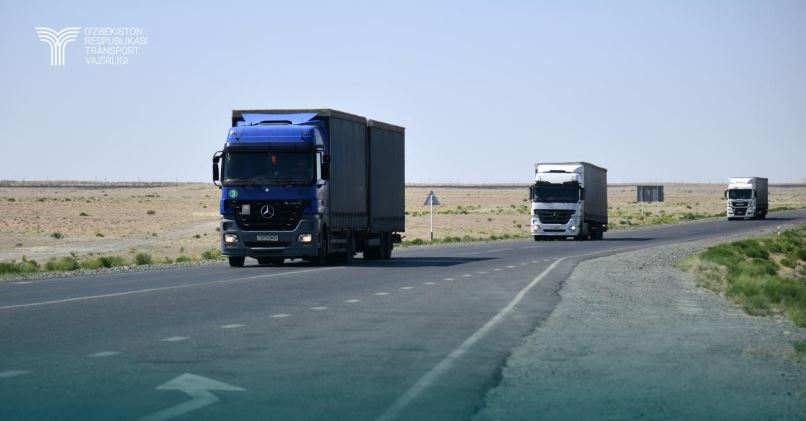
Another aim of the decree is to improve infrastructure and procedures for tractor-trailer-borne goods, including an expanded network of truck stops and more efficient systems to reduce transit times at border crossings, according to Eurasianet. Transport Minister Ilkhom Mahkamov reportedly told news outlet O’zbekiston 24 that the plan additionally calls for improvements in connections to Afghanistan and Turkmenistan, with the aim of boosting trade with Iran, Turkey, Azerbaijan and Georgia.
The measures outlined in the decree are designed to synchronize Westward-oriented trade corridors with the newly launched Kyrgyz-Uzbek-China railway. Officials from the three countries held a ground-breaking ceremony in late December, but construction work isn’t expected to commence in earnest until the summer of 2025.
The Trans-Caspian International Transport Route (TITR), known as the Middle Corridor, is a multilateral institutional development linking the containerized rail freight transport networks of China and the European Union through the economies of Central Asia, the Caucasus, Turkiye, and Eastern Europe. The multilateral, multimodal transport institution links Caspian and Black Sea ferry terminals with rail systems in China, Kazakhstan, Azerbaijan, Georgia, Turkiye, Ukraine, and Poland.