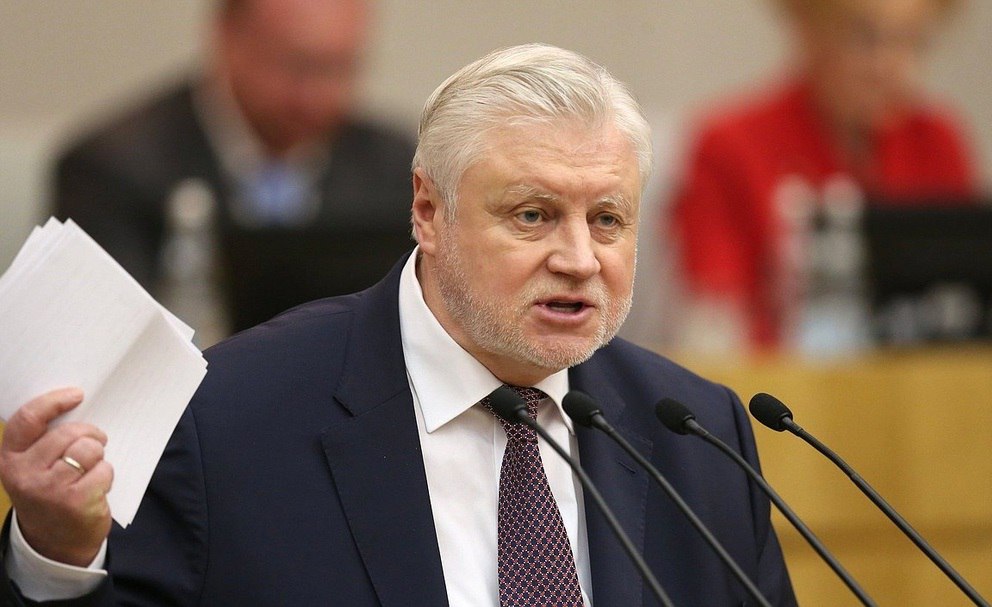
Russian media note that the proposal by the Russian politician Sergey Mironov, who the leader of the Fair Russia – For Truth faction in the State Duma (Russia’s lower chamber of parliament), is driven not by logic but by general anti-migrant rhetoric.
He has proposed introducing a state fee on migrant money transfers. “Last year, citizens of Kyrgyzstan and Uzbekistan transferred over US$14 billion from Russia to their home countries. The vast majority of migrants do not pay any taxes in Russia, yet they are withdrawing enormous amounts of money from the country,” Mironov wrote on his Telegram channel.
He recalled that in 2021, the government discussed introducing an additional commission on migrant transfers, but “the Ministry of Finance stalled the matter.”
“When it comes to raising tariffs, excise duties, and fees for Russian citizens, our officials have no hesitation. But when it comes to touching foreigners, they start playing dumb," Mironov emphasized.
According to his calculations, if a 3% fee were introduced, the treasury would receive over 45 billion rubles from transfers to just two countries—Kyrgyzstan and Uzbekistan.
“Do we really not need this money?! We will prepare a legislative initiative and submit it to the State Duma,” he concluded.
A familiar rhetoric
MP Mironov has long been known for his anti-migrant rhetoric, both in Russia and in Central Asian countries—the main suppliers of labor to the Russian Federation. In the past, he has repeatedly proposed various radical measures against migrants.
For example, he suggested taxing migrant money transfers back in 2023.
At the time, he proposed introducing a 1% state commission on money transfers sent by labor migrants to other countries. Mironov believes that "by transferring money abroad, labor migrants contribute to weakening Russia's economic potential."
Earlier that same year, in April, after the head of Russia’s Investigative Committee, Alexander Bastrykin, reported an increase in criminal cases involving migrants in 2022, Mironov demanded radical government action:
- Introduce a visa regime with countries from which migrants are coming;
- Stop mass granting of Russian citizenship to migrants and revoke it in cases where it was issued in violation of the law;
- Hold employers accountable for crimes committed by migrants.
In the spring of 2021, Mironov urged law enforcement agencies to “grab migrants by the scruff of the neck and throw them out of the country.”
“Our people have nowhere to work, and it is migrants who are largely responsible for this,” Mironov wrote on his Twitter (now X).
Unrealistic proposals
Mironov’s radical proposals regarding migrants have been made almost every year, but none have been taken seriously by Russian authorities, as they are, to put it mildly, unfeasible.
For instance, his latest idea—to introduce a state fee on migrant money transfers—is unprecedented in global practice and does not follow logical reasoning.
The fact is that migrant remittances consist of wages they have earned through labor—income that has already been taxed and is not subject to additional mandatory state payments.
In other words, the government has already received its share from these earnings.
The only entity entitled to charge a commission on these transfers is the payment system itself, as a service fee.
As for Mironov's claim that “the vast majority of migrants do not pay any taxes in Russia” (referring to illegal employment), this is an issue that Russian authorities should be addressing with local employers who conceal their income, rather than targeting migrants.
A struggle for anti-migrant voter support?
The Russian government consistently rejects initiatives from State Duma members aimed at restricting the rights of foreigners in the country, according to an article published by Nezavisimaya Gazeta last Tuesday.
The article notes that the most active campaigns against migrants are led by the Liberal Democratic Party of Russia (LDPR) and Fair Russia – For Truth (FRFT). The names of party leaders Leonid Slutsky and Sergey Mironov frequently appear as sponsors of such legislative proposals.
The competition between them for the support of the anti-migrant electorate is intensifying, and the authorities appear to tolerate their radical rhetoric. "This is probably because the LDPR and (FRFT have limited potential for gaining additional votes in the upcoming elections," the author of the article concludes.
The piece highlights that Mironov is preparing an initiative to impose additional fees on migrant money transfers, while a group of LDPR members on February 4 proposed tightening regulations on migrant labor.
Their two bills set strict time limits for employment and introduce penalties for staying in Russia without legal grounds.
At the end of last year and the beginning of this year, several anti-migrant legislative proposals were submitted by Duma parties, but LDPR and FRFT stood out the most.
The Communist Party of the Russian Federation (CPRF) makes such proposals far less frequently. Moreover, it is worth noting that the party’s leader almost never signs off on such initiatives, whereas Slutsky and Mironov do so regularly.
The idea of taxing migrant remittances was previously proposed by former LDPR leader Vladimir Zhirinovsky back in 2013. At the time, Russian experts dismissed his initiative as purely publicity-driven and demagogic, targeting a specific audience and electorate while distracting from real issues like capital outflows and resource drainage abroad.
However, the government’s repeated dismissals of such proposals make it clear that anti-migrant rhetoric is primarily a political tool, with no real intention of turning these ideas into laws.
"It is worth noting that these efforts come from parliamentary parties operating within the official political system. If the presidential administration does not block such activities, it likely either permits them or outright approves of them," Nezavisimaya Gazeta concludes.