The government of Tajikistan is significantly increasing excise tax rates on certain types of petroleum products, including gasoline, diesel fuel, and liquefied gas.
According to government’s resolution — detailed in a letter from the Tax Committee leadership to tax authorities and taxpayers, a copy of which was obtained by Asia-Plus — the changes will take effect on May 1 this year.
Specifically, the excise rate on gasoline will increase by 27.3% (from €55 to €70 per ton), diesel fuel by 87.5% (from €8 to €15 per ton), and liquefied gas by 150% (from €4 to €10 per ton).
Experts note that raising excise taxes on transport fuel typically leads to higher final prices for consumers, which can trigger a chain reaction affecting the broader economy — leading to price increases across a wide range of goods and services.
This happens because excise taxes are factored into the cost structure of fuel, and their rise increases operational costs, particularly for the transportation of goods.
Fuel sellers usually pass these additional costs onto consumers, ultimately driving up product prices.
As fuel prices rise, it often provokes a domino effect throughout the economy, increasing the costs of other goods and services since fuel is crucial for transportation and other industries.
The Ministry of Finance expects external excise collection to grow by 25.8% in 2025 compared to the 2024 plan, and domestic excise collection to grow by 17.1%.
Overall, more than 1.3 billion somonis are expected to be collected through excise taxes by the end of the year.
Over the first two months of this year, 172.4 million somonis were collected from external excise and 70.2 million somonis from domestic excise — representing increases of 1.7% and 0.9%, respectively, compared to the same period in 2024.
Overall, state budget revenues in the first two months of this year rose by 11.7% compared to the approved plan.
Market situation
According to statistical data, more than 292,000 tons of petroleum products were imported into Tajikistan in the first quarter of this year — 15.9% more than during the same period last year.
In particular, 134,000 tons of gasoline was imported by 13 suppliers, with Gazpromneft-Tajikistan accounting for 56.3% of the supply. Gasoline imports increased by 9,500 tons this year.
Diesel fuel imports reached 133,000 tons, up 34,500 tons compared to the first quarter of 2024.
Twenty-six companies were involved in diesel fuel supply, with Gazpromneft-Tajikistan holding a 53.5% market share.
As for liquefied gas, 86,800 tons were imported in the first quarter — 46,000 tons less than in January–March 2024.
Fourteen suppliers were involved in liquefied gas supply, with Temur Oil LLC (30%) and Allat LLC (25.2%) dominating the market.
Over 61% of liquefied gas imports came from Russia, and about 39% from Kazakhstan.
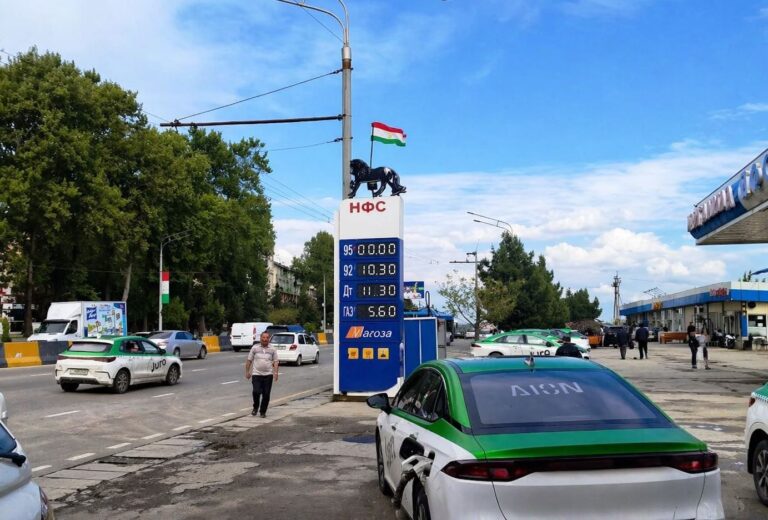
Over the first quarter of this year, the average prices per liter at gas stations across the country were: 10.40 somonis for 92-octane gasoline, which is the most sought-after grade of automobile gas in the country; 10.80 somonis for diesel fuel; and 6.90 somonis for liquefied gas.
As of April 28, the average prices per liter in Dushanbe were: 9.80 somonis for 92-octane gasoline; 10.00 somonis for diesel fuel; and 6.80 somonis for liquefied gas.
It is worth noting that fuel prices in the regions are generally higher compared to the capital.
How prices are formed
According to fuel suppliers and sellers, the final retail price at gas stations in Tajikistan is based on three main components: 1) the enterprise (production) price; 2) transportation costs; and 3) domestic taxes.
Over the first quarter of this year, according to official statistics, each ton of fuel cost Tajik suppliers on average: US$761.00 for gasoline; US$763.00 for diesel fuel; and US$681.00 for liquefied gas.
Experts emphasize that oil and petroleum products themselves are relatively inexpensive — it is the taxes that make them costly.
It is important to note that Tajikistan has been receiving duty-free Russian petroleum products since 2013.
Over the first quarter of this year, 92.4% of petroleum products and 61.1% of liquefied gas imports came from Russia.
Currently, the following domestic charges apply in Tajikistan: customs clearance fees; VAT; and excise tax.
After paying these, suppliers add a markup based on their financial and economic conditions and coordinate it with the Antimonopoly Service.
Fuel suppliers also point out other expenses, such as: fees for unloading petroleum products from railway wagons ("transshipment"); storage costs at oil depots; and delivery costs to gas stations
Fuel suppliers estimate their average net profit after all expenses at around 5%.