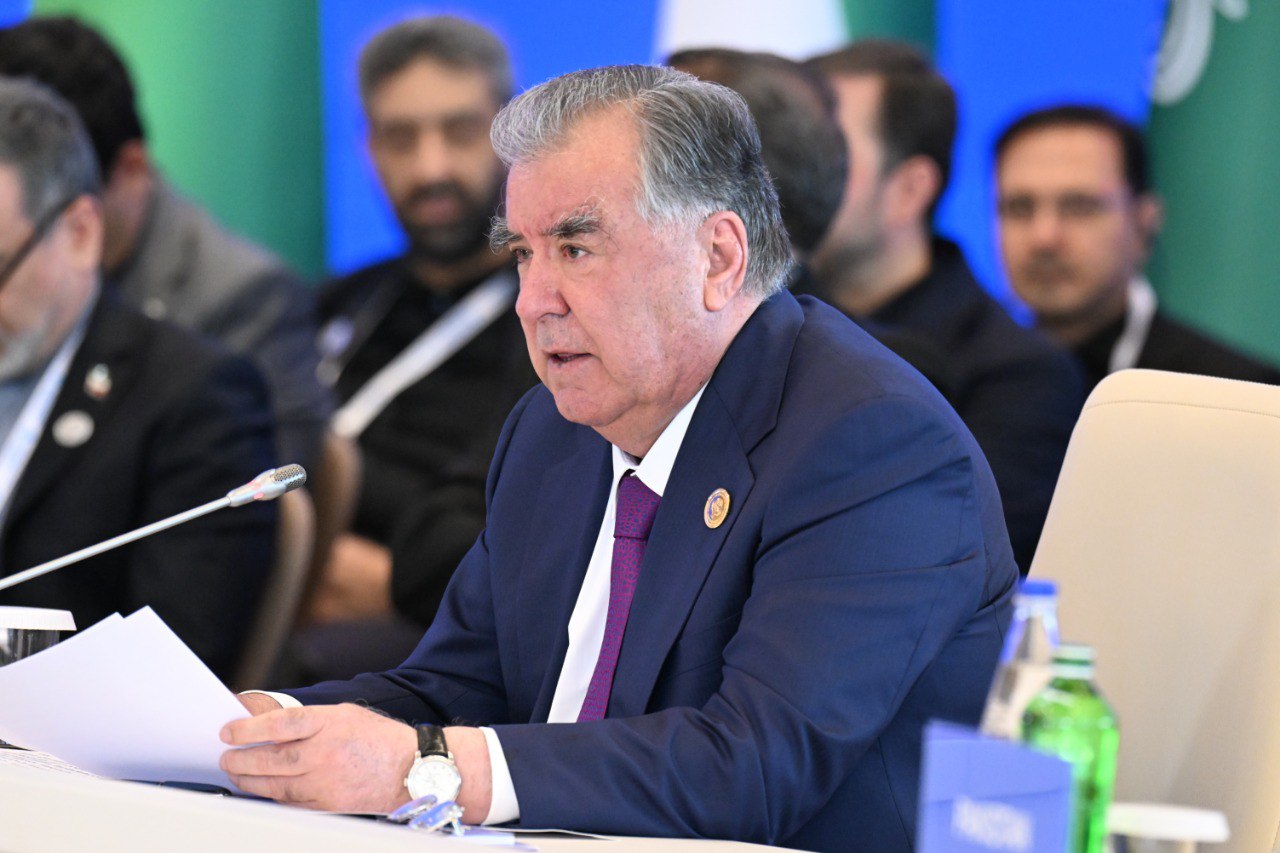
Tajikistan's President Emomali Rahmon emphasized the vital role of trade and transport cooperation among the member states of the Economic Cooperation Organization (ECO) on July 4 during his speech at the 17th ECO Summit held in Khankendi, Azerbaijan.
The Tajik president’s official website says that addressing the summit, President Rahmon stated that economic and transport collaboration with ECO countries remains a key priority in Tajikistan’s foreign policy. He stressed that strengthening ties in trade, transportation, industry, and agriculture is essential for ensuring sustainable development across the region.
"In this regard, it is appropriate for the ECO Secretariat, in coordination with member states, to not only analyze the implementation of the 'ECO Vision 2025' document but also to draft a new strategic framework to fully leverage the existing trade and economic potential," Rahmon noted.
According to the president, trade with ECO countries accounted for 33% of Tajikistan's total foreign trade volume in 2024—an 18% increase compared to the previous year.
President Rahmon also underlined the importance of developing transport links and multimodal corridors, removing trade and transport barriers, facilitating transit, and integrating road, rail, and air networks among ECO nations. He proposed concrete steps toward the digitalization of transit and transport documentation to enhance the efficiency and transparency of cooperation in the sector.
"Such measures will expand trade, ensure its security, save time, and boost international cargo volumes," Rahmon said.
The Tajik leader further urged increased collaboration in strategic areas such as energy—particularly renewable energy—green energy production, and the advancement of a green economy. He highlighted the importance of completing the CASA-1000 high-voltage power transmission project and recommended developing a Regional Energy Security Strategy for the ECO.
President Rahmon also called for broader cooperation in other key areas including industry, agriculture, food security, environmental protection, climate adaptation, science and education, healthcare, and tourism.
The Economic Cooperation Organization or ECO is a Eurasian political and economic intergovernmental organization that was founded in 1985 in Tehran by the leaders of Iran, Pakistan, and Turkiye. It provides a platform to discuss ways to improve development and promote trade and investment opportunities. The ECO is an ad hoc organization under the United Nations Charter. The objective is to establish a single market for goods and services, much like the European Union. After the dissolution of the Soviet Union, the ECO expanded to include Afghanistan, Azerbaijan, Kazakhstan, Kyrgyzstan, Tajikistan, Turkmenistan and Uzbekistan in 1992.